Grosse Pointe Farms has two sewer districts. Lakeside was separated in the early 2000s; Inland is still combined, and its partial separation is due to be substantially complete by the end of 2027. The city expects less wet-weather flow, but existing Inland footing drains stay on the combined sewer, and no sewer project stops water seeping through a basement wall. Clark Basement Waterproofing fixes that seepage from the outside, dug by hand.
Why do basements leak in Grosse Pointe Farms?
Most Farms houses are more than 65 years old, and most stand in ground that stays wet close to the surface for part of the year. The 2020–2024 American Community Survey puts the city’s median year built at 1946, a decade older than the Wayne County median of 1956. Of the Farms’ 4,199 housing units, 85.9% went up before 1960 and 35.9% in 1939 or earlier, while only 4.2% date from 1990 or later. The city’s 2023 Master Plan adds that many of its single-family homes were built in the 1920s and 1930s, and that some are older still.
Walls that old have had decades to shift, and nobody can predict exactly where a foundation will crack. Building Science Corporation draws the practical lesson: keep water away from the wall instead of trusting the wall to stop it.

Clay toward Mack, sand toward the lake
The ground changes as you cross town. We sampled USDA’s Wayne County soil survey at 344 points on land inside the city and grouped them from the Mack Avenue edge to the lakeshore:
| Part of the city | Most common soil | Share poorly drained |
|---|---|---|
| Inland third (Mack Avenue side) | Ziegenfuss clay till | About half |
| Middle third | Brems sand, then Avoca | About 1 in 10 |
| Lakeside third | Brems sand, then Avoca | About 1 in 20 |
Drainage improves toward the water: about 4 in 10 lakeside points drain moderately well or better, against about 1 in 8 on the Mack side. Ziegenfuss is the hard case. USDA’s series description calls it poorly drained till over dense till that water barely moves through, able to hold water perched at the surface from October to May on undisturbed ground. Under the Farms’ built-up lots the survey still places the seasonal water table about 20 inches down. Brems, the usual soil along Kercheval and Kerby, is sand that sheds water fast, yet its seasonal high water table sits only 2 to 3 feet below the surface.
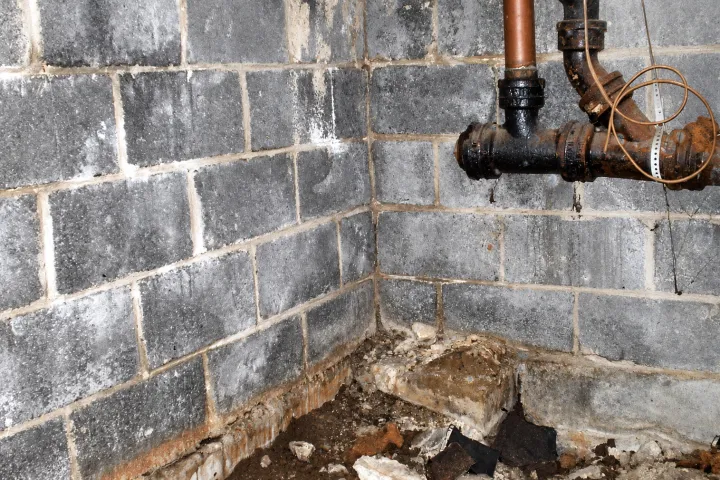
Across the whole sample, about 9 in 10 points have a seasonal high water table within roughly 39 inches of the surface. A basement floor lies several feet lower, so in a wet spring the bottom of many Farms basement walls can sit in saturated soil that presses in wherever the wall gives it a path (our hydrostatic pressure guide explains the force).
Is it a sewer backup or seepage in your Farms basement?
Work out how the water got in before you hire anyone. The two problems have different fixes, and in the Farms your sewer district affects the risk of a backup:
| What you saw | Where it came from | Who fixes it |
|---|---|---|
| Water or sewage coming up through a floor drain | The sewer | A licensed plumber, often with a backwater valve |
| Damp patches, trickles or a wet crack on a wall | Saturated soil pressing on the wall | Exterior waterproofing or crack repair from outside |
| Water spreading from the floor-wall joint after long rain or the thaw | Water collecting around the footing | Exterior waterproofing with new drain tile |
The city laid its sewers in the 1920s as a combined system, with sewage and storm water sharing one pipe, according to its 2023 project plan. As basement flooding became more frequent, the Lakeside District was separated in the early 2000s. The Inland District stayed combined, and the same plan cites “chronic basement, street and surface flooding” there. On May 25, 2011, the city logged 288 flooding calls, every one from a home, and its engineer told council the storm topped 100-year intensity, more than the local combined pipes and the Kerby/Chalfonte pumping station could carry at the peak (June 6, 2011 minutes).
A smaller storm that September came with an extended power failure at the pump station. By 2013 the city had upgraded the Kerby station, added a generator and fitted restricted catch basins in the Inland District to slow street water into the combined pipes (engineering review, Jan. 25, 2021). Then the June 25–26, 2021 storm dropped 6.50 inches on Grosse Pointe Farms, by the National Weather Service’s count, and became federal disaster DR-4607.
What will the Inland District separation change?
Less storm water in the combined pipes. The city describes the program’s purpose as “decreasing the likelihood and severity of residential basement flooding” and expects it to cut wet-weather flow into the combined sewers and the Kerby Road pump station by about one-third (March 9, 2026 council packet). It is being built under three contracts:
| Contract and work | Status |
|---|---|
| 1. Storm sewer and force main through Tonnancour Place, Kercheval and the Country Club of Detroit | Begun spring 2025; about 95% done by March 2026 |
| 2. Stormwater pump station at Moross and Chalfonte | Site mobilization and erosion controls under way in late September 2026 |
| 3. Inland separation northwest of Chalfonte and Moross and along Chalfonte, with partial separation on Mount Vernon, McMillan and McKinley | Begun July 7, 2026; substantially complete by the end of 2027, the city estimates |
What it leaves alone matters as much. In the separated areas, new storm sewers take the street water while the old combined pipes keep carrying sewage and footing-drain flow, as the city’s consultant laid out the design (Feb. 8, 2021 packet). Nothing in the project touches the soil against your foundation, so water coming through a wall has to be stopped at the wall.
Which city rules affect an exterior dig in Grosse Pointe Farms?
A handful, starting at the lakeshore. We pull the permits the job needs ourselves, and the Building Department answers permit questions at (313) 885-4285. The rules that bear on a foundation dig:
- Within 500 feet of Lake St. Clair. The city’s building permit application says any earth change within 500 feet of the lake, or larger than one acre, needs a Wayne County Soil Erosion and Sedimentation Control permit, plus state permit coverage, before any earthwork can begin.
- Downspouts stay off the sewer. Code 11-10 bars a Certificate of Occupancy while a gutter downspout is tied into the combined or sanitary sewer, unless the Director of Public Service grants a written exemption.
- Footing drains and the storm system. The stormwater ordinance, Code 8-08, lists foundation and footing drains among the discharges exempt from its ban on non-stormwater discharges to the storm sewer, provided they don’t violate state water quality standards.
- Concrete and the street. Driveways and sidewalks have their own concrete permit ($50 base fee on the 2026 form), and any work in the street right-of-way needs a Right-of-Way permit.
What changes for homes on the lake?
The flood map, first of all. The 2023 Master Plan puts 11 lakeshore buildings partly or wholly in FEMA flood Zone AE and says they must carry flood insurance. It adds that the shoreline floodplain has grown over the last ten years and describes the seawall as rapidly losing its structural integrity. NOAA’s St. Clair Shores gauge logged its highest monthly mean since 1970, 577.55 feet (IGLD 1985), in July 2019. On a lakefront lot, rule out surface water and grading first. We know of no local measurements showing how far the lake’s level reaches under inland Farms streets.
Which Clark services suit a Grosse Pointe Farms house?
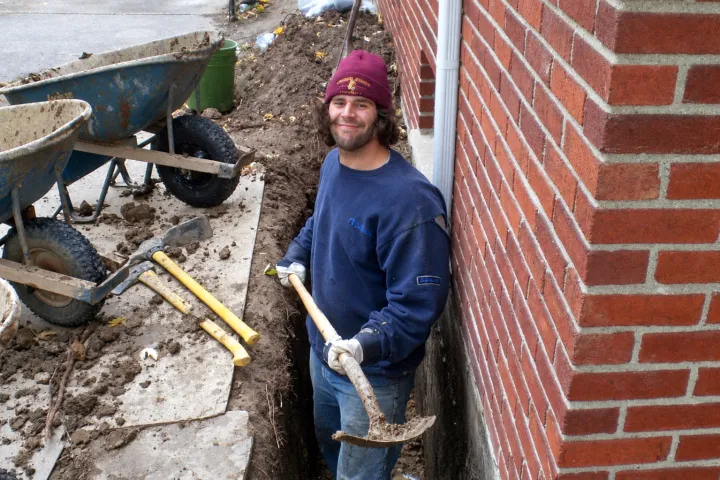
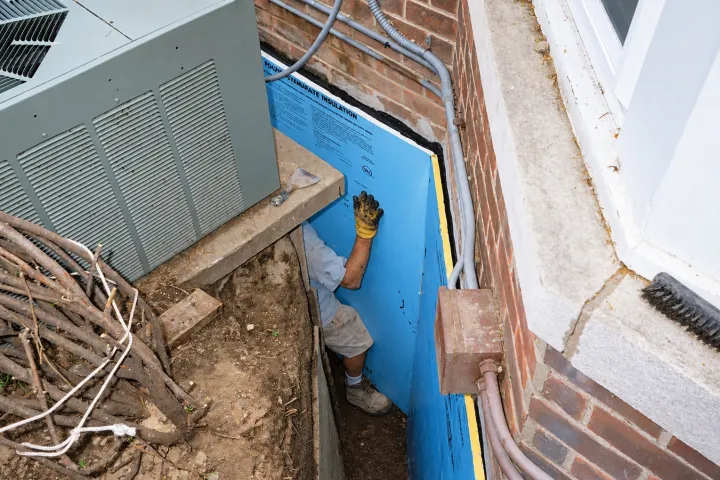
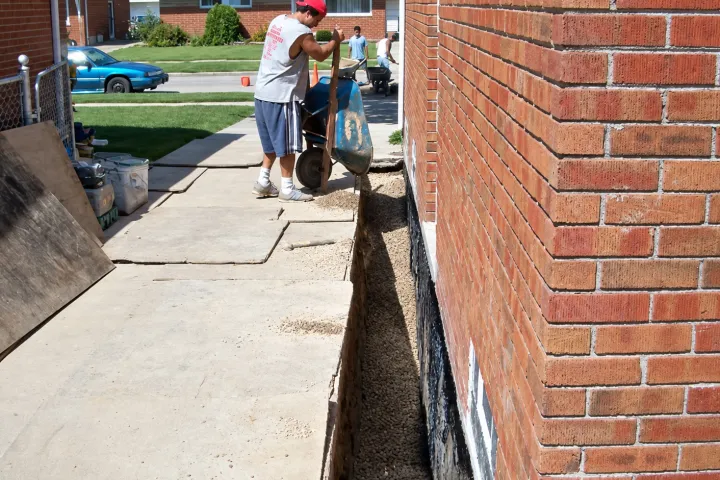
The one that matches where your water comes from. Every Clark service is done from outside the wall, with the digging done by hand, and Clark does not install interior drainage systems.
| Service | Where it fits in the Farms |
|---|---|
| Exterior basement waterproofing | Pre-1960 walls that seep in wet seasons, especially on the clay till toward Mack. |
| Foundation crack repair | A crack that weeps after long rains or the thaw, sealed with hydraulic cement from the soil side. |
| Basement leak diagnosis | Inland District homes, where floor-drain water and wall water can both turn up; the free visit tells them apart before any digging. |
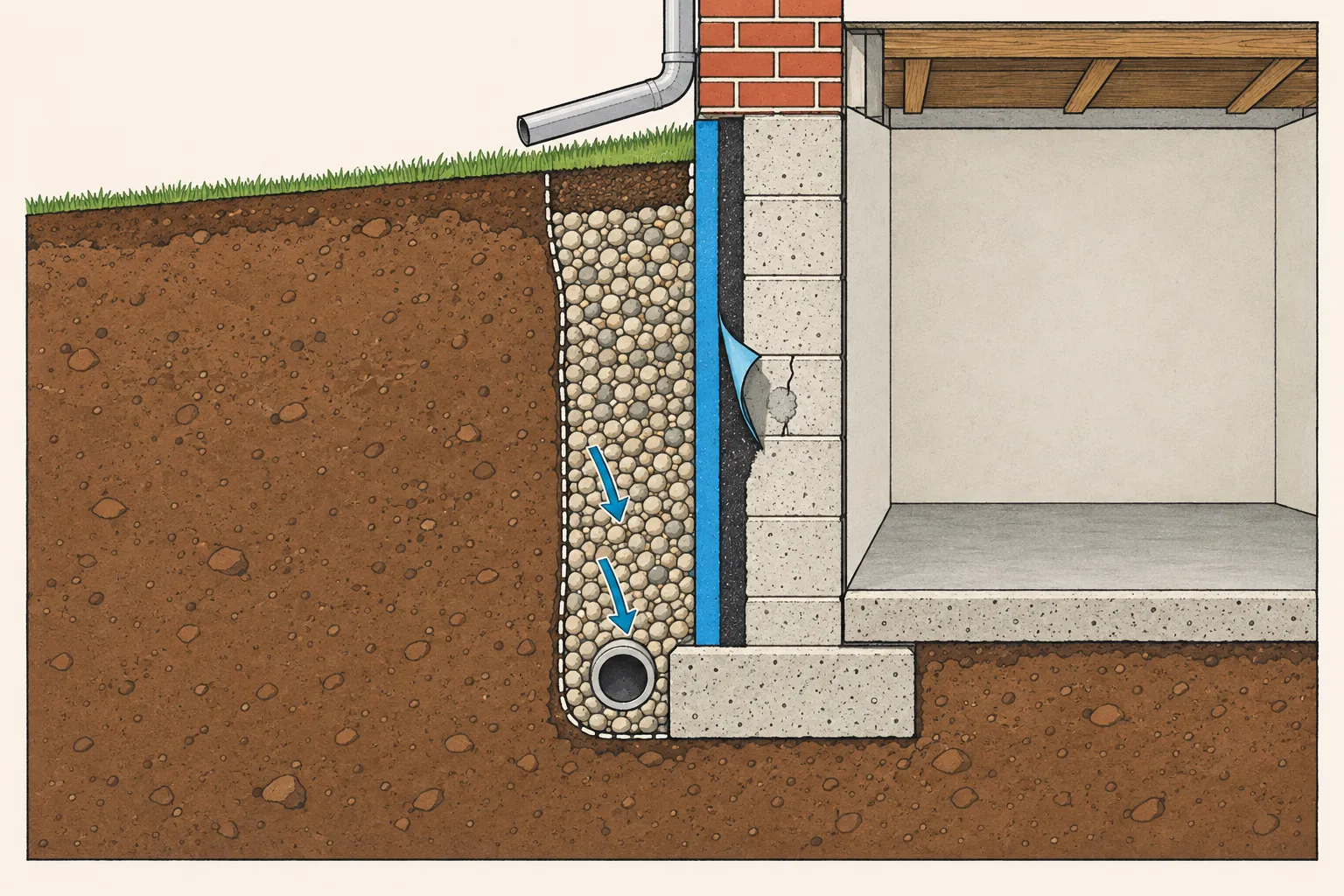
| Drain tile replacement | New tile in pea stone along the footing. Where it drains depends on your lot and city rules; Mark will show you during the estimate. |
| Exterior water management | With downspouts off the sewer, roof water has to cross the yard. The 2015 Michigan Residential Code calls for ground that falls 6 inches in the first 10 feet. |
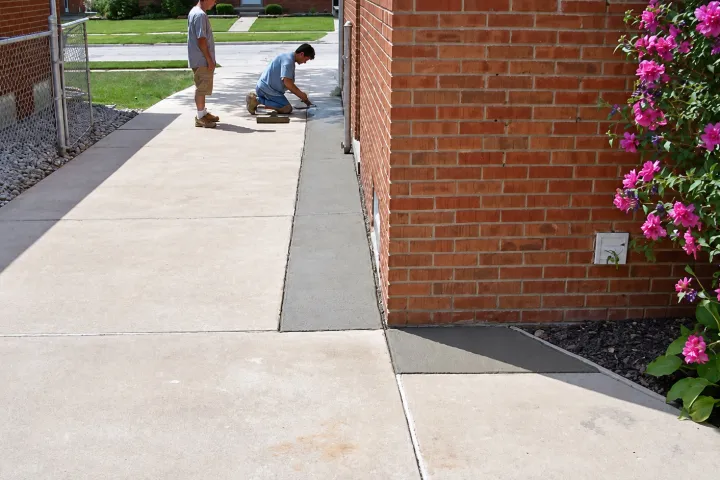
| Waterproofing under porches, decks and concrete | A stoop, walk or drive over the leaking wall is cut out, the wall waterproofed by hand and the concrete replaced. |
Clark Basement Waterproofing is a family-owned company founded in 1956 that serves Grosse Pointe Farms and its neighbors. Compare the Farms with the other Pointes in our Grosse Pointe overview, see how a Clark job runs from first shovel to restored yard, or book a free on-site estimate.
Grosse Pointe Farms by the numbers
- The median Grosse Pointe Farms home was built in 1946, ten years before the Wayne County median of 1956 (American Community Survey 2020–2024). Source data.census.gov (opens in a new tab)
- Of the city’s 4,199 housing units, 85.9% were built before 1960 and 35.9% in 1939 or earlier; only 4.2% date from 1990 or later (ACS 2020–2024). Source data.census.gov (opens in a new tab)
- Ziegenfuss, a poorly drained clayey till, is the most common soil mapped in the inland third of the city, on the Mack Avenue side (USDA SSURGO sample, 2026). Source websoilsurvey.nrcs.usda.gov (opens in a new tab)
- USDA describes undisturbed Ziegenfuss soil as holding a perched water table from about 6 inches above to 6 inches below the surface, October through May. Source soilseries.sc.egov.usda.gov (opens in a new tab)
- Brems sand, common along Kercheval and Kerby, is moderately well drained, but its seasonal high water table sits 2 to 3 feet below the surface (USDA). Source soilseries.sc.egov.usda.gov (opens in a new tab)
- About 9 in 10 sampled points in the city have a seasonal high water table within roughly 39 inches of the surface (USDA SSURGO grid sample, Sept. 2026). Source websoilsurvey.nrcs.usda.gov (opens in a new tab)
- The city’s sewers were built in the 1920s as a combined system. The Lakeside District was separated in the early 2000s; the Inland District remains combined. Source grossepointefarms.org (opens in a new tab)
- Inland District separation (Contract 3) began July 7, 2026, and the city estimates it will be substantially complete by the end of 2027. Source grossepointefarms.org (opens in a new tab)
- The city expects the separation program to cut wet-weather flow into the combined sewers and the Kerby Road pump station by about one-third. Source grossepointefarms.org (opens in a new tab)
- In the separated areas, new storm sewers are added while the existing combined sewers keep collecting sanitary and footing drain flows, per the city’s engineering consultant (2021). Source grossepointefarms.org (opens in a new tab)
- Code 11-10 withholds a Certificate of Occupancy while any gutter downspout is connected to the combined or sanitary sewer, unless the city grants a written exemption. Source grossepointefarms.org (opens in a new tab)
- The city’s building permit application says earth changes within 500 feet of Lake St. Clair need a Wayne County soil erosion permit before any earthwork begins. Source grossepointefarms.org (opens in a new tab)
- On May 25, 2011, the city received 288 flooding calls, all residential; its engineer said the storm exceeded a 100-year event (council minutes). Source grossepointefarms.org (opens in a new tab)
- The National Weather Service recorded 6.50 inches of rain at Grosse Pointe Farms in the June 25–26, 2021 storm, declared FEMA disaster DR-4607. Source weather.gov (opens in a new tab)
- The city’s 2023 Master Plan counts 11 lakeshore buildings partly or completely within FEMA flood Zone AE, and five more close to it. Source grossepointefarms.org (opens in a new tab)
Neighborhoods we serve in Grosse Pointe Farms
- Inland District
- Lakeside District
Updated