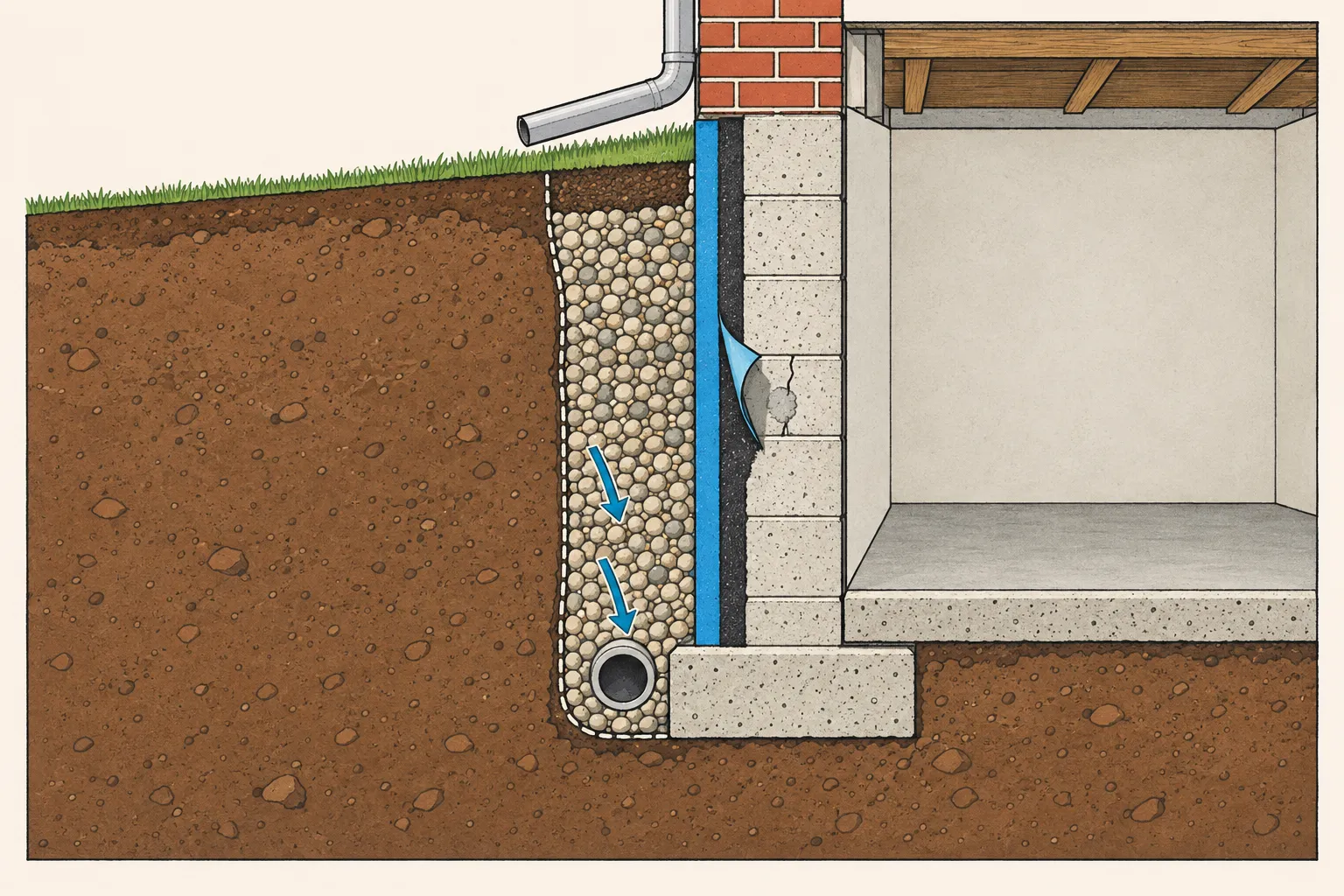
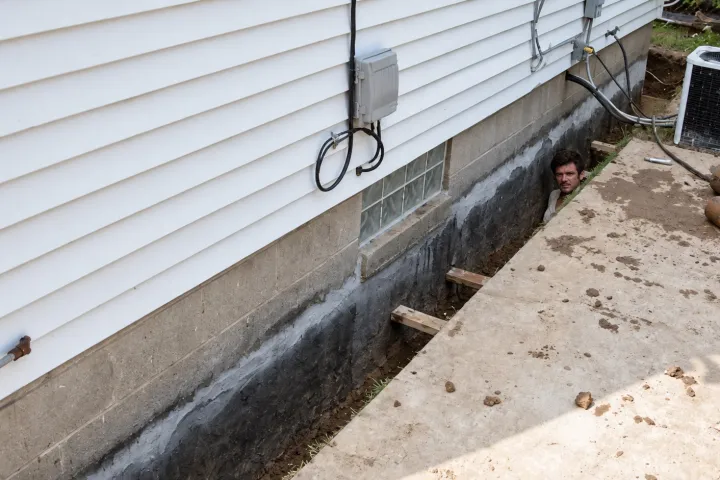
Grosse Pointe Woods is in FEMA Zone X (minimal flood hazard) citywide, yet its Department of Public Works logged 264 flooded basements in 2021. The city runs a combined sewer and sits largely on poorly drained clay till. Clark Basement Waterproofing, a family-owned company founded in 1956, stops wall and crack seepage from the outside, digging by hand. A sewer backup through a floor drain needs a plumber.
Why do so many Grosse Pointe Woods basements take on water?
Mostly from two things a floodplain map leaves out: clay that stays soaked against the foundation, and a combined sewer that can back up when a storm outruns it. It isn’t mapped river or lake flooding. The FEMA flood maps the city adopted in 2021 put all of Grosse Pointe Woods in Zone X, the minimal-hazard category, and the city’s 2024 Master Plan calls its flood risk low.
The Department of Public Works keeps a yearly count of flooded basements reported to it, and the swings are large:
| Year | Flooded basements reported to DPW |
|---|---|
| 2011 | 62 |
| 2012 | 8 |
| 2013 | 25 |
| 2014 | 33 |
| 2015 | 8 |
| 2016 | 38 |
| 2017 | 12 |
| 2018 | 10 |
| 2019 | 20 |
| 2020 | 16 |
| 2021 | 264 |
| 2022 | 6 |
| 2023 | 20 |
A postwar city on drained marshland
Most of the houses went up in one wave. In the 2020–2024 American Community Survey, the median home in the Woods was built in 1953, and 62% of the city’s 6,604 housing units date from 1940 through 1959. About 90% were built before 1970. The city’s chronology records 568 residential building permits in 1950, the year the village became a city, and a 1955 regional planning report that called the Woods the fastest-growing Grosse Pointe community.
The ground needed help first. In 1850 the interior was so marshy that farming stayed near the lake, the chronology notes. By the 1950s building had outrun drainage, and Woods voters approved a large drain project in 1958 so construction could resume after a five-year moratorium: the $11 million Grosse-Gratiot Drain, covering the Black Marsh Drain, the Girard Drain and the Milk River, which once flowed through the Woods.
What wet clay till does to a 1950s wall
Ziegenfuss map units (poorly drained clay till mixed with urban fill) cover more than half of the city in USDA’s Wayne County soil survey, and Wauseon units, also poorly drained, cover roughly another tenth. USDA rates both “Very limited” for dwellings with basements for a single reason, the depth to the saturated zone, which the survey sets at about 20 inches down in the Ziegenfuss units and 17 inches in the Wauseon unit.
It gets tighter with depth. In the main Ziegenfuss map unit, the survey records dense till from about 4.7 feet down, roughly half clay, passing water around a hundred times more slowly than the clay above it. If your basement floor is 6 or 7 feet below the yard, the bottom of the wall stands at that depth. Rain that sinks into the looser backfill beside the house has nowhere quick to go, and saturated soil pushes on the wall with about 62.4 pounds per square foot for each foot of depth, finding cracks, the wall-floor joint and tired drain tile. The hydrostatic pressure guide has the physics.
Did the water come up the floor drain or in through the wall?
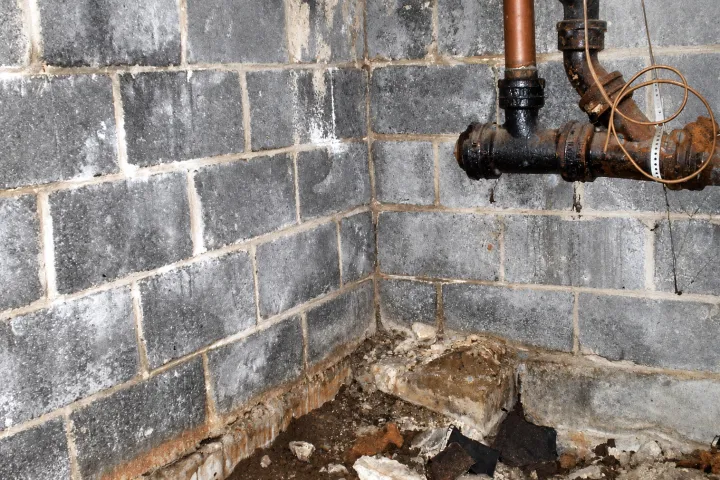
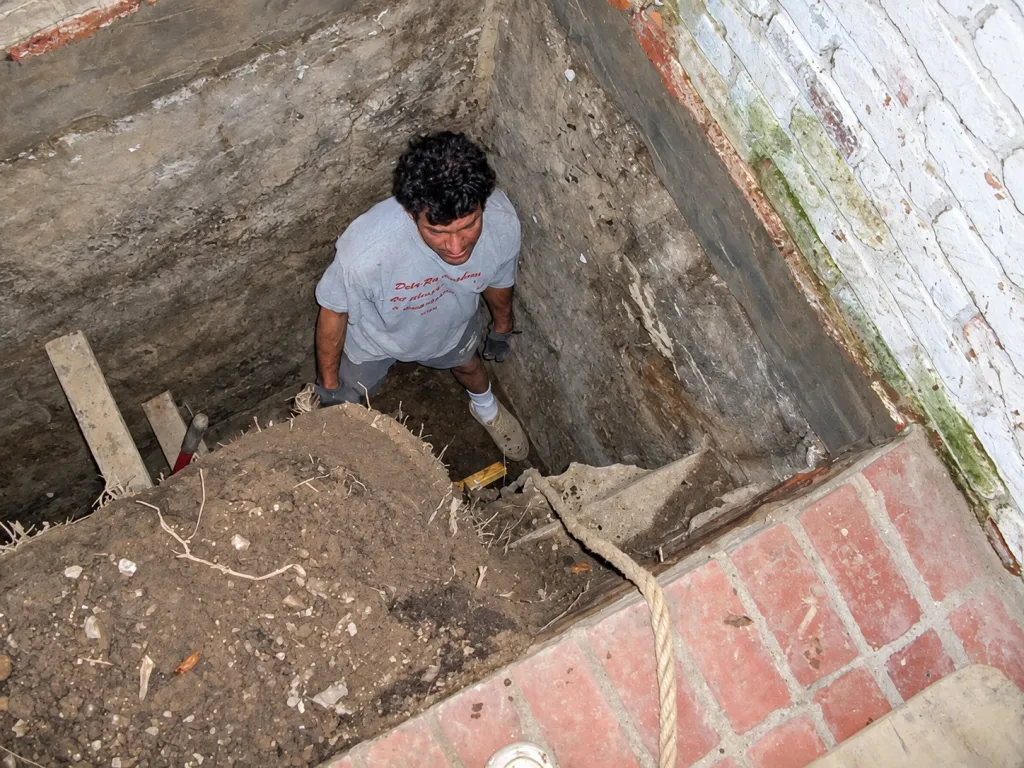
Start with where it entered. Water that rose out of a floor drain came from the sewer. Water that ran down a wall, seeped from a crack or spread from the edge of the floor came from the soil outside, and that is the kind Clark’s exterior work deals with. Sewer water calls for a plumber, often for a backwater valve, and plumbing work here can’t start until the city issues a plumbing permit. More signs are in the sewer backup vs. seepage guide.
Both problems turn up here because of how the city drains. Grosse Pointe Woods runs a city-owned combined sewer, one set of pipes for sewage and rainwater, laid in the street or in a rear-yard easement along almost every street. The Torrey Road Pump Station lifts that flow to the Milk River pump station, and Wayne County’s Milk River basin holds it in wet weather before pumping it on to the county’s Northeast Sewage Disposal System. When a storm sends more water than that chain can move, sewage can back up through basement floor drains.
The city has spent decades keeping rain out of those pipes. A 1992 ordinance ordered downspouts off the sewer, and today’s Sec. 44-230 lists “the reduction of basement flooding” among its purposes. Restricted catch-basin covers have been required since March 1, 1998 (Sec. 44-288), and Wayne County began a $38.8 million rebuild of worn-out Milk River pumps and equipment in November 2016. None of that reaches the clay against your wall, which keeps pushing after the sewer drains down.
If sewage did come up, Michigan law gives you 45 days from finding the damage to notify the city in writing (MCL 691.1419), and the City Clerk posts a notice of claim form for floods and sewer backups. For the insurance side, see what homeowners policies usually cover.
What does the city check in your basement when you sell?
The walls and the downspouts. Grosse Pointe Woods requires a Certificate of Occupancy whenever a home changes ownership, and the inspection follows the standards in Sec. 8-69. Item (1)(n) says all basement walls “shall be inspected for evidence of foundation failure.” Their condition goes on the report, and repairs are required if the inspector states in writing that the failure is serious enough to affect the safety of owners or occupants. Sec. 8-71 separately has the inspector confirm the downspouts are disconnected from the sewer.
The certificate itself says it is not a warranty of the home’s condition (Sec. 8-61), so buyers still bring their own inspectors, and Michigan’s seller disclosure form asks outright whether there has been evidence of water in the basement (MCL 565.957).
If the report flags a crack that lets water in, sealing it from the outside is the work Clark does, with a written 10–15 year warranty; the length depends on the job. If it describes a wall that is bowing, shifting or cracking from movement, have a structural engineer look at it before anyone waterproofs.
What local rules shape a dig beside a Grosse Pointe Woods house?
A handful, and a couple are particular to the Woods. We pull the permits the job needs ourselves. These are the rules that come up:
- A building permit and two inspections. The city issues exterior waterproofing jobs a building permit, and the Building Department inspects the open trench before backfill and again at a final inspection. Because a building permit covers the work, the city clerk’s separate excavation permit in Sec. 20-29 does not apply (Sec. 20-30). The permit application doubles the fee for work started without a permit.
- Dirt in the street. Leaving stones, dirt or equipment on the street for any length of time takes a Building Department permit.
- Sewers behind the house. City sewer lines run in the street or a rear-yard easement along almost every street (Master Plan), so locate yours before a back wall is dug.
- Buried lines. We call MISS DIG 811 before every job. MISS DIG asks for at least three business days’ notice and does not mark private lines, such as sprinkler pipes.
- Trees on city land. Parkway trees get a six-foot buffer (Sec. 46-62); see the answers below.
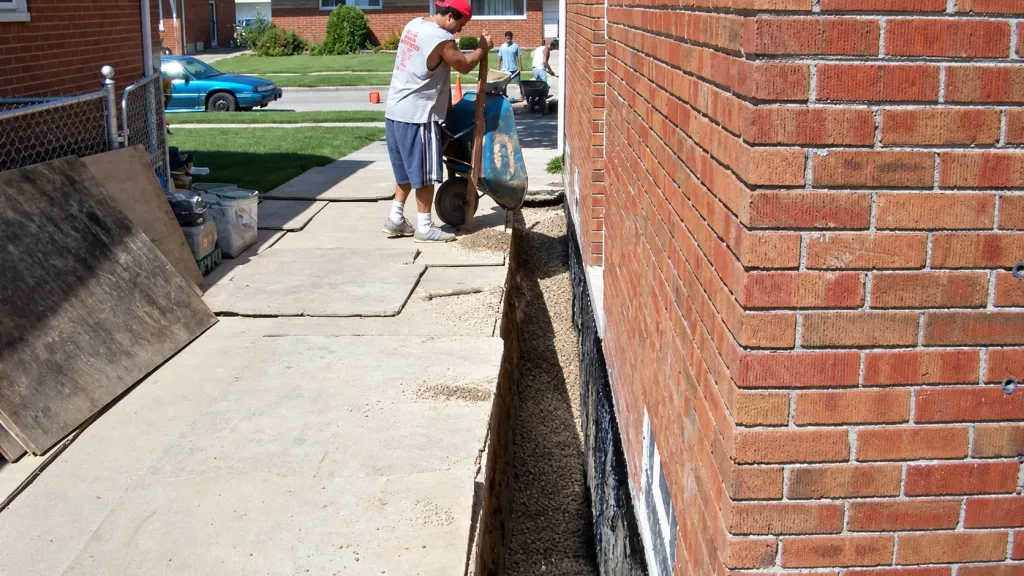
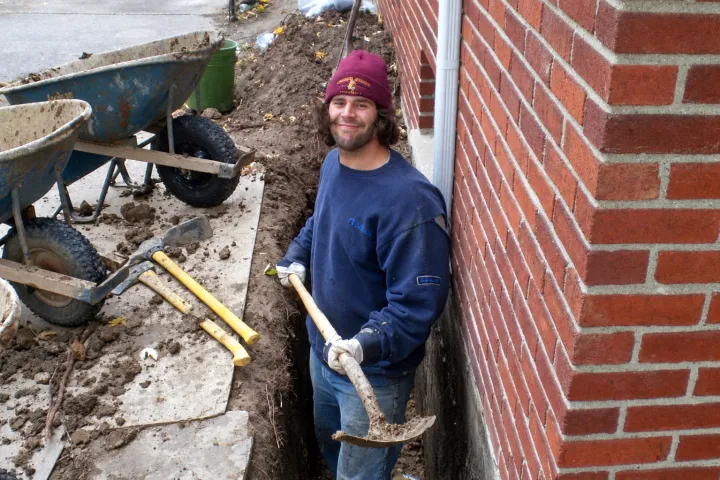
Clark digs every trench by hand, so no backhoe rolls across the lawn, which matters in a city where SEMCOG’s 2022 estimate puts tree canopy at 33.7% of the city (Master Plan). Bushes along the foundation usually stay; the crew works around them.
Which Clark service matches what you see in your basement?
All of Clark’s work is on the outside of the foundation. Match what you’re seeing to the service, and to the local detail that goes with it:
| What you see | The service, and the local detail |
|---|---|
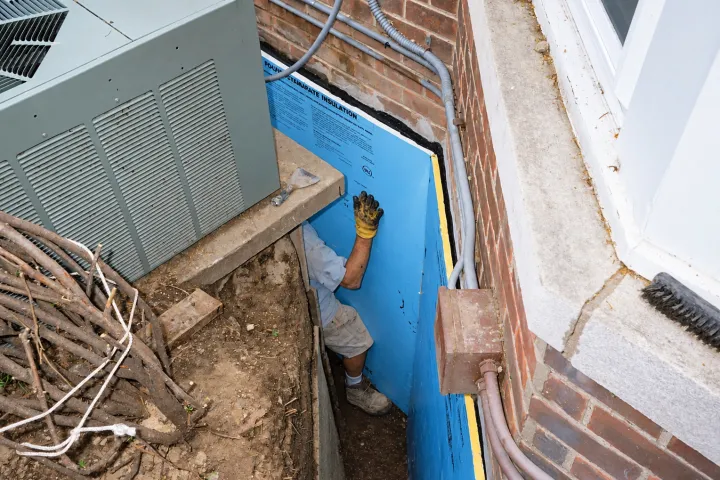
| Water at the floor edge or through the wall after long rains | Exterior basement waterproofing. Hand-dug to the footing and sealed from outside, on walls mostly more than 55 years old. |
| One crack that weeps every spring | Foundation crack repair. Sealed on the soil side, ideally before a sale inspection looks at your walls. |
| Not sure if it was the sewer or the wall | Basement leak diagnosis. The first question on a combined sewer; the free estimate starts there. |
| Wet at the base of the wall; old tile no longer drains | Drain tile replacement. Where the new tile drains depends on your house and the city’s rules; Mark shows you during the estimate. |
| Downspouts emptying at the foundation | Exterior water management. Downspouts stay off the sewer and aim toward the street or your own yard, not a neighbor’s. |
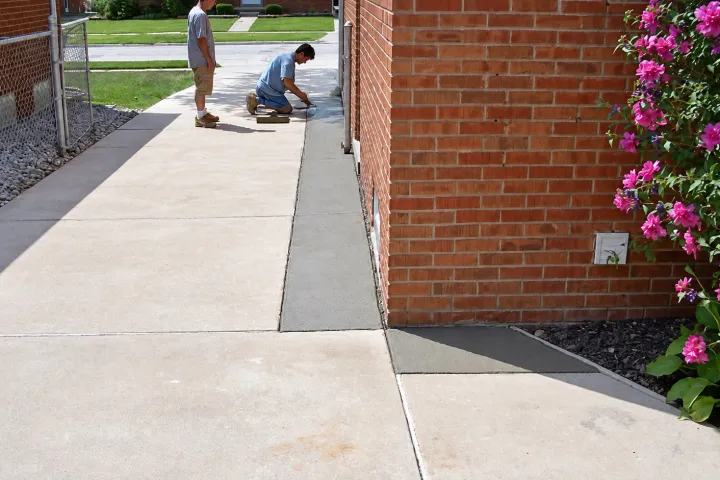
| A porch, walk or driveway over the leaking wall | Waterproofing under porches, decks and concrete. Clark cuts the concrete, waterproofs by hand and replaces it. |
Clark Basement Waterproofing, a family-owned company founded in 1956, serves Grosse Pointe Woods and the neighboring Pointes. See how a Clark job runs, or ask for a free on-site estimate.
Grosse Pointe Woods by the numbers
- The median Grosse Pointe Woods home was built in 1953 (American Community Survey 2020–2024, table B25035). Source data.census.gov (opens in a new tab)
- 62% of the city’s 6,604 housing units were built from 1940 through 1959, and about 90% before 1970 (ACS 2020–2024, table B25034). Source data.census.gov (opens in a new tab)
- The city issued 568 residential building permits in 1950, the year Grosse Pointe Woods incorporated as a city, per its official chronology. Source gpwmi.us (opens in a new tab)
- Woods voters approved a drain project in 1958 so building could resume after a five-year moratorium, according to the city’s history pages. Source gpwmi.us (opens in a new tab)
- Ziegenfuss map units (poorly drained clay till mixed with urban fill) cover more than half of the city in USDA’s Wayne County soil survey (map units clipped to the city boundary, Sept. 2026). Source websoilsurvey.nrcs.usda.gov (opens in a new tab)
- USDA rates Ziegenfuss and Wauseon soils “Very limited” for dwellings with basements because the saturated zone sits about 17 to 20 inches down. Source websoilsurvey.nrcs.usda.gov (opens in a new tab)
- In the city’s main Ziegenfuss map unit, USDA records dense till about 4.7 feet down that is roughly half clay and very slowly permeable. Source websoilsurvey.nrcs.usda.gov (opens in a new tab)
- Grosse Pointe Woods has a city-owned combined sewer, with lines in the right-of-way or rear-yard easement of almost every street (2024 Master Plan). Source gpwmi.us (opens in a new tab)
- The city’s combined sewage flows to Wayne County’s Milk River Retention Treatment Basin, then to the county’s Northeast Sewage Disposal System. Source gpwmi.us (opens in a new tab)
- City Code Sec. 44-230 bars downspouts from the sewer and names the reduction of basement flooding as one of its purposes. Source library.municode.com (opens in a new tab)
- The Department of Public Works logged 264 flooded basements in 2021, up from 16 in 2020, after historic rains in June and July. Source gpwmi.us (opens in a new tab)
- DPW logged 62 flooded basements in 2011, a year of heavy rains, and 8 in 2012 (DPW 2012 annual report). Source gpwmi.us (opens in a new tab)
- At least 179 homeowners who gave Grosse Pointe Woods as their city registered with FEMA after the June 25–26, 2021 storm (OpenFEMA, pulled Sept. 2026). Source fema.gov (opens in a new tab)
- FEMA’s National Flood Hazard Layer shows Grosse Pointe Woods in Zone X, minimal flood hazard, on maps the city adopted effective Oct. 21, 2021. Source msc.fema.gov (opens in a new tab)
- Grosse Pointe Woods issues building permits for exterior waterproofing, with an open-trench inspection before backfill and a final inspection; a building permit makes the clerk’s excavation permit unnecessary (City Code Secs. 20-29 and 20-30). Source bsaonline.com (opens in a new tab)
- When a home changes ownership, the Certificate of Occupancy inspection checks basement walls for evidence of foundation failure (City Code Sec. 8-69(1)(n)). Source library.municode.com (opens in a new tab)
- Digging within six feet of a city-owned tree needs permission from the city administrator, and the tree must be boxed (City Code Sec. 46-62). Source library.municode.com (opens in a new tab)
Updated