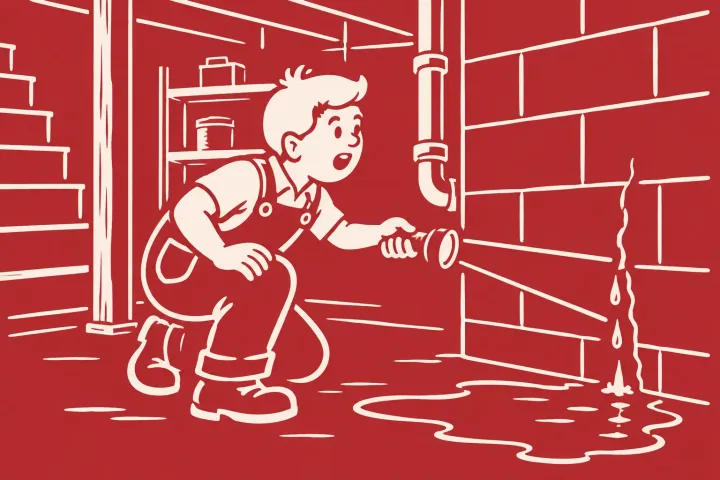
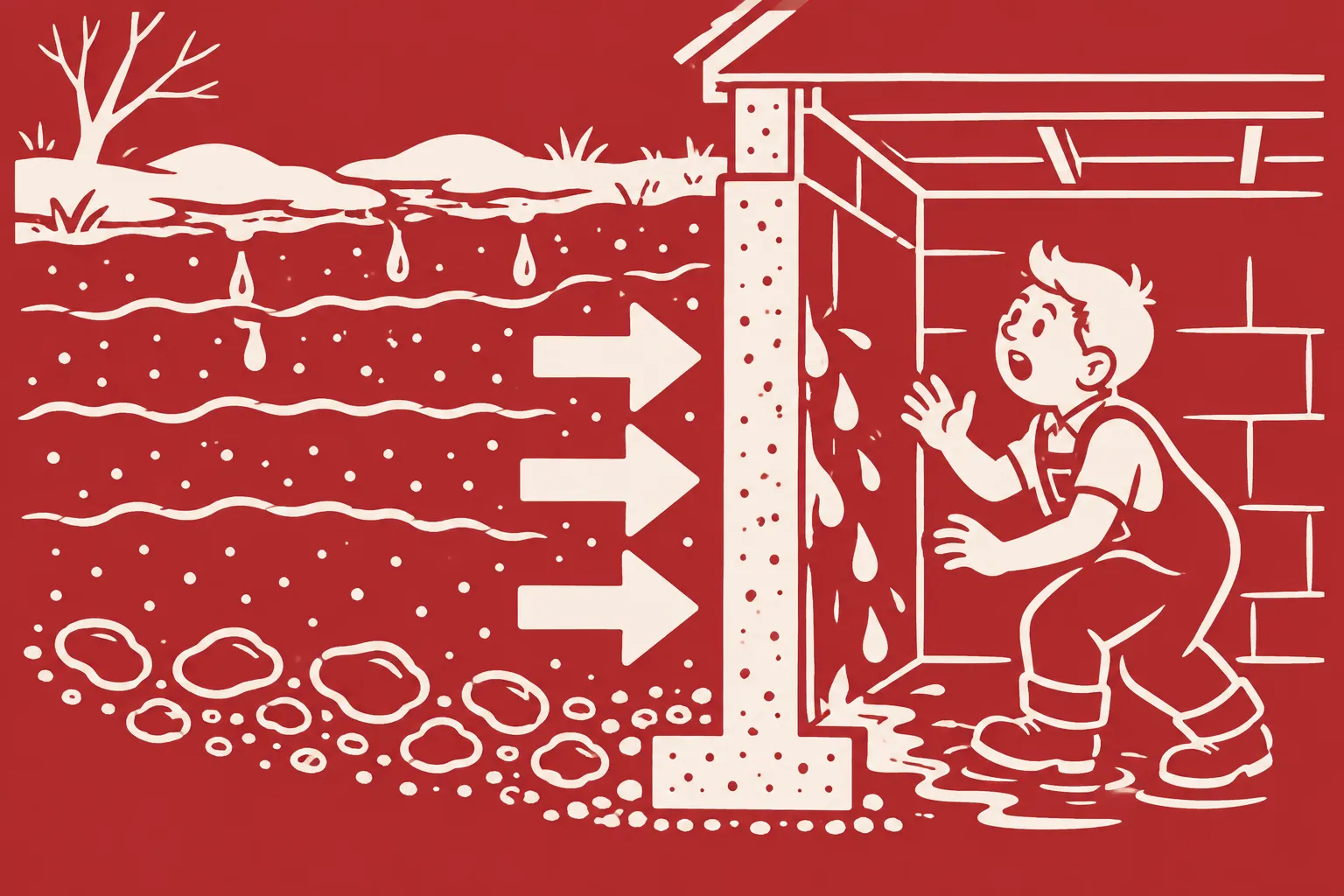
In St. Clair Shores, Warren and much of the Grosse Pointes, hydrostatic pressure, the push of water held in saturated soil against a basement wall, builds in wet, slow-draining soils, much of them clay. It grows by about 62.4 pounds per square foot for every foot of water-soaked soil. These soils stay wet from late fall into spring, so pressure peaks at thaw and after long rains. Exterior drain tile relieves it by giving the water a way out.
If your basement stays dry all summer and takes on water every March, there is a physical reason: water collects in the soaked soil beside the wall and presses on it until it finds a way in. Here is that pressure in plain numbers, why local soils make it worse, and what relieves it, including options Clark doesn’t sell.
What is hydrostatic pressure in a basement?
Hydrostatic pressure is the push of standing water against whatever holds it back. Around a basement, the water sits in the soil beside the wall, and the wall is what holds it back. The push grows with depth: about 62.4 pounds per square foot for every foot of water-soaked soil above a given point, because a cubic foot of water weighs about 62.4 pounds (U.S. Geological Survey).
What matters is how high the water stands in the soil, not how much water there is. A narrow band of soaked backfill pushes as hard at the bottom of the wall as a whole saturated yard would, if the water stands just as high.
| Depth of soaked soil above the point | Pressure (lb per sq ft) | Pressure (psi) |
|---|---|---|
| 1 foot | 62 | 0.43 |
| 4 feet | 250 | 1.73 |
| 7 feet (about the height of a basement wall) | 437 | 3.03 |
| 8 feet | 499 | 3.47 |
Over a whole 7-foot wall soaked to the surface, the water alone pushes with about 1,530 pounds on every running foot of wall. That’s an illustration, not an engineering calculation: real water levels are usually lower, and the soil adds its own load.
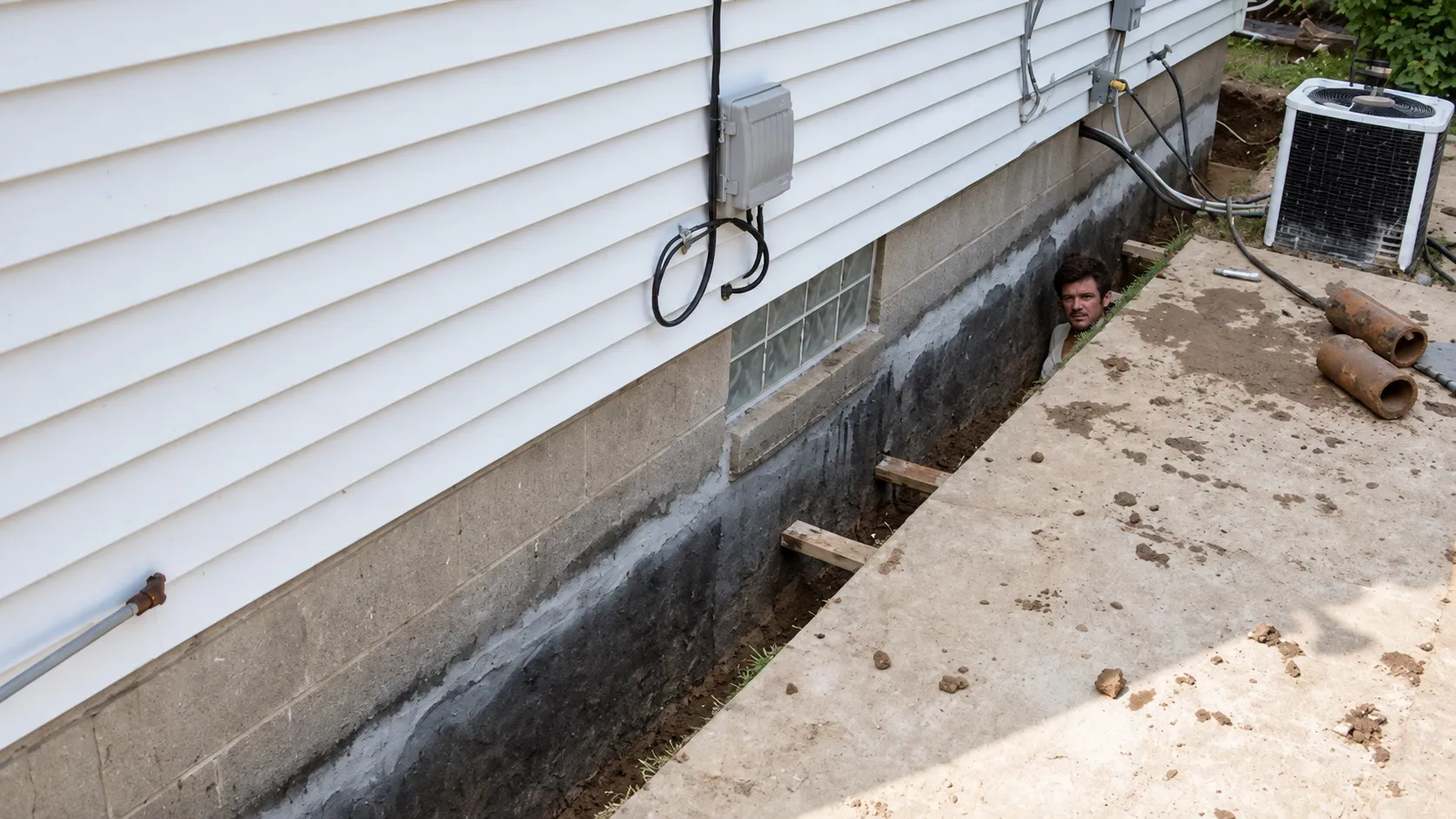
A wall doesn’t have to fail for that pressure to cause a leak. Building Science Corporation, in a report written for the U.S. Department of Energy, puts it plainly: water that builds up against a foundation “results in hydrostatic head pressure, which will push water through any available joints, imperfections, or cracks in the foundation.” In an older basement, that means cracks, the joint where the wall meets the floor, and the mortar joints of a block wall.
Why does clay soil make hydrostatic pressure worse?
Because clay holds water and lets it go slowly. Michigan’s residential code rates clay soils medium to poor for drainage: water percolates through them at 2 to 4 inches an hour, or under 2 inches an hour for the poorest clays, compared with more than 4 inches an hour for sand and gravel (2015 Michigan Residential Code, Table R405.1). When the backfill beside your wall fills with water, the clay around it lets that water out only a little at a time, so the water level stays up, and so does the pressure.
Is clay soil bad for a foundation? It doesn’t rule out a dry basement, but it is why footing drains matter so much here. Much of this area is a flat former lakebed, and USDA’s soil survey shows it:
| Area | Main soils mapped by USDA | What the soil survey shows |
|---|---|---|
| St. Clair Shores | Toledo and Lenawee (clay laid down in an old glacial lake), Ziegenfuss, Sims | More than 80% of the city’s soils are poorly or very poorly drained. Nearly all of it is rated “very limited” for homes with basements, because of ponding, a shallow saturated zone and shrink-swell. Toledo subsoil is about half clay. |
| Warren | Lenawee and Sims clay loams; Selfridge loamy sand | More than three-quarters of the city has wet soils, and about four-fifths is rated “very limited” for basements. Even the Selfridge sand turns to clay-loam till about 30 inches down. |
| Grosse Pointe Woods | Ziegenfuss (about half the city) and Wauseon | Poorly drained, over clay till. Both soils are rated “very limited” for basements. |
| Grosse Pointe Farms | Ziegenfuss toward Mack; Brems and other sandier soils toward the lake | The wettest soils are inland. Toward the lake the soils are sandier and drain better. |
| Grosse Pointe Shores | Livonia: sand over a dense clay layer about 5 feet down | Rated “somewhat limited” for basements. The water table is shallowest in April. |
| Harrison Township | Lamson and Minoa fine sandy loams | Sand, not clay, but wet: nearly all of the residential area is rated “very limited” for basements, mostly because the water table sits near the surface. |
The cities describe the same ground. A 2011 memo from Warren’s acting city engineer calls Warren “extremely flat,” with heavy clay that lets little water soak in. Grosse Pointe Woods’ own history notes the “marshy character of the interior” in 1850, and building there stopped for five years until voters approved a large drain project in 1958.
Two cautions. Sand doesn’t mean dry: in the sandier parts of Warren, Grosse Pointe Shores and Harrison Township, it sits on slow clay or a high water table within the depth of a basement wall. And the survey describes natural soil. Grading, fill and sewers have changed built-up lots, so the map shows the tendency; what is against your wall is what counts. Local detail for each city is on our St. Clair Shores, Warren, Grosse Pointe Woods and Grosse Pointe Farms pages.
What are the signs of hydrostatic pressure?
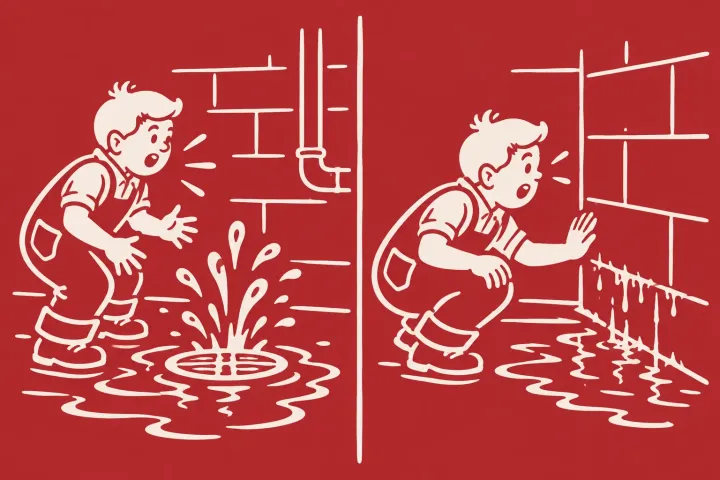
The signs show up low on the wall and at the floor, and they come and go with the wet season. Watch for:
- Water at the joint where the wall meets the floor, after a thaw or several days of rain.
- A crack low on the wall that weeps in spring and is dry by late summer.
- A white, chalky crust on the wall. That’s efflorescence: salt left behind as water moves through the masonry and dries (Building Science Corporation).
- A damp band or tide line along the bottom of the wall, or paint peeling low on the wall.
- Water seeping up through cracks in the floor when the ground is soaked.
These show that water got through, not how much or how fast. A wall that bows inward or has a long horizontal crack is a different matter: those can signal soil pressure on the wall itself and need a structural engineer’s opinion before anyone waterproofs it. Our guide to basement wall cracks explains the patterns, and foundation crack repair covers sealing a leaking crack from the outside.
Why do basements leak most in spring?
Because that’s when the ground around your house is wettest. From late fall through spring, the main clay soils here hold water at or near the surface, and snowmelt and spring rain land on ground that is already full. With nowhere to go, the water rises in the backfill against your wall, and the pressure rises with it. USDA’s soil data spell out the calendar:
- Toledo (the most common soil in St. Clair Shores): a high water table from 1 foot above to 1 foot below the surface, November to May in normal years.
- Lenawee (common in St. Clair Shores and Warren): frequently ponded from November to May.
- Ziegenfuss (Grosse Pointe Woods and the inland Farms): a perched water table within about 6 inches of the surface, October to May.
- Lamson (Harrison Township’s main soil): wet at the surface from November through April, and lowest, about 3 feet down, in August.
Winter also sets up the leak. Michigan’s code puts the frost line at 42 inches, so roughly the top 3½ feet of a foundation wall sits in ground that can freeze. Water expands by about 9 percent when it freezes (USGS), so water in a crack near the surface can pry at it and help widen it over time. The air at Selfridge Air National Guard Base crosses freezing on about 85 days a year (NOAA 1991–2020 normals), though a wall below ground sees far fewer freeze-thaw cycles than the air.
The lake runs on a different calendar. Lake St. Clair tends to peak in summer: at the NOAA gauge in St. Clair Shores, the monthly average rose about 1.6 feet from March to July 2026, about twice the average March-to-July rise since 1968, and the gauge’s record monthly highs came in June and July of 2019 and 2020. A leak that appears every March and dries up by August is following the soil’s wet season, not the lake.
Big summer storms can soak the ground in hours instead of months. The National Weather Service reported 4.00 inches of rain in 2 hours at St. Clair Shores on July 28, 2025. But when a basement floods in a storm like that, check where the water came from. In the June 2021 storm, basements backed up across the Grosse Pointes, Dearborn and parts of Detroit, and a report to the Great Lakes Water Authority’s board found the rain far exceeded what the sewers were designed to carry. A sewer backup is a sewer problem, not wall pressure. See sewer backup or seepage.
How does exterior drain tile relieve hydrostatic pressure?
It gives the water a way out before it can build up against the wall. Drain tile laid along the footing, bedded in stone that drains freely, collects water at the bottom of the wall and carries it away, so the water in the soil against your wall can’t rise as high. Less water standing against the wall means less pressure on it.
That is the approach building scientists recommend. Building Science Corporation’s report for the Department of Energy says water accumulation “is prevented by the use of drainage,” starting with free-draining backfill and a working footing drain. Michigan’s code requires foundation drains around basements except on well-drained sand and gravel, and requires them to discharge by gravity or by pump into an approved drainage system (2015 Michigan Residential Code, R405.1).
The coating and membrane on the wall are the second line of defense. In the words of Building Science Corporation’s Joseph Lstiburek, “waterproofing needs to be ‘perfect’ whereas keeping the water away from the foundation wall allows you to not be ‘perfect’.” Draining the soil takes the pressure off; sealing the wall handles what still reaches it. On a Clark job, the crew does both, from the outside, in this order:
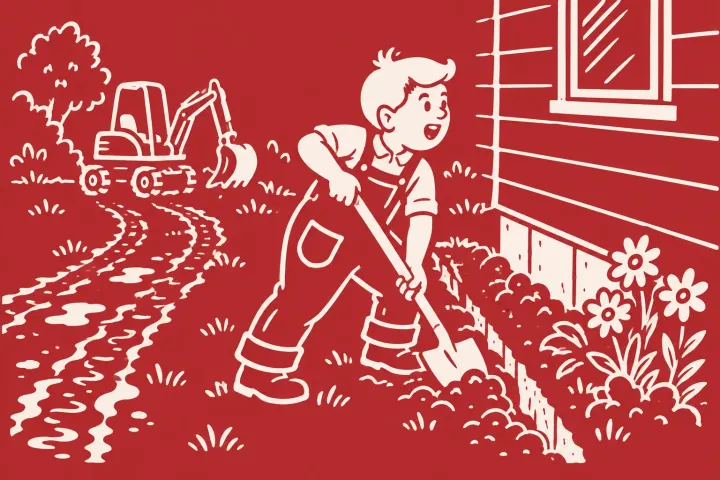
- Dig by hand down to the footing, with no backhoes.
- Seal cracks with hydraulic cement.
- Coat the wall with tar.
- Cover it with a waterproof membrane.
- Lay new drain tile and pea stone along the footing.
- Backfill and restore the yard.
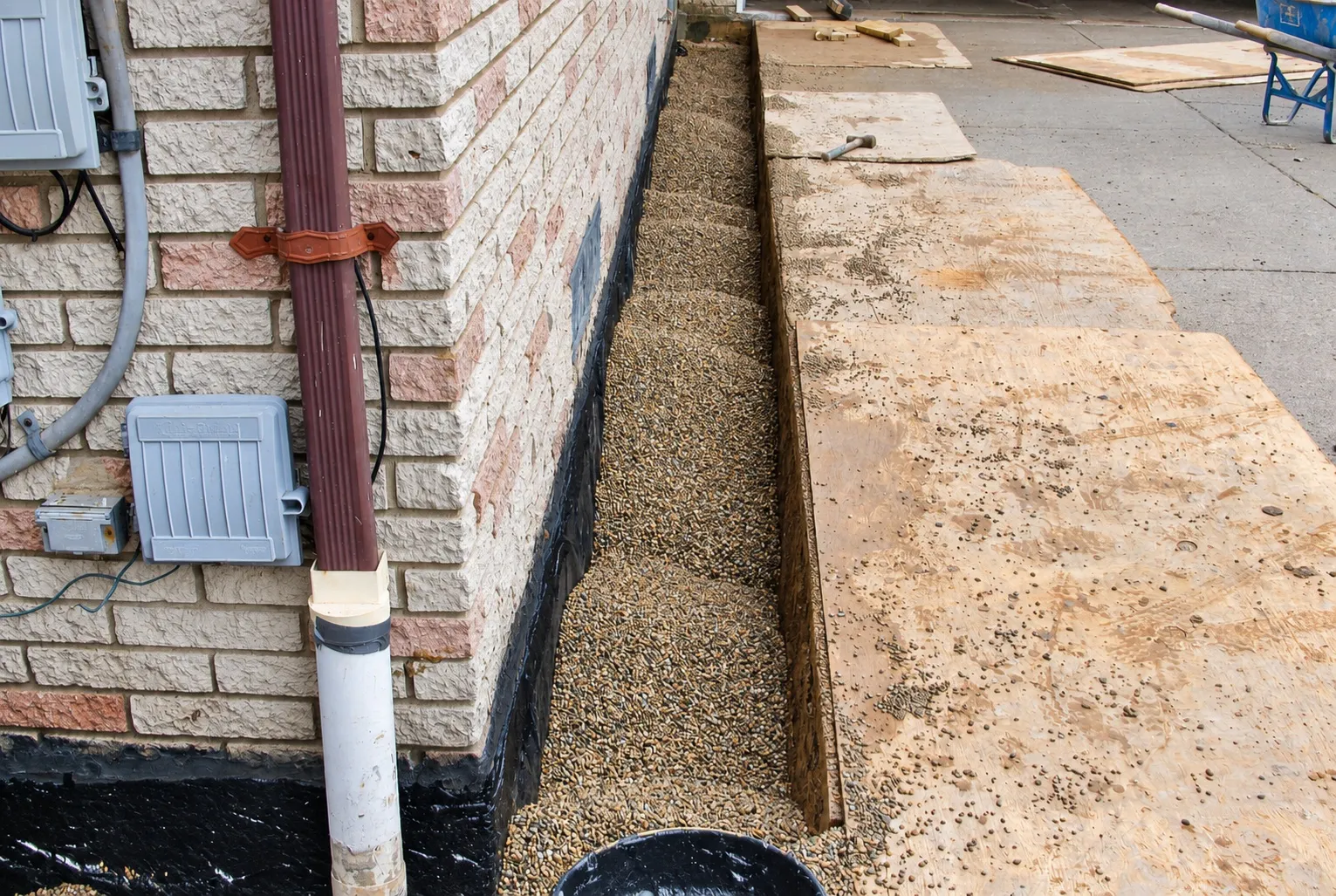
The stone matters as much as the pipe. Stone drains far faster than clay, so water that reaches the backfill runs down to the tile instead of sitting against the wall. Where the new tile drains depends on your house and your city’s rules: St. Clair Shores and Grosse Pointe Park, for example, don’t allow footing drains to connect to the sanitary sewer. Mark will show you where the water will go during the estimate.
Most Clark jobs take 3 to 7 days. The work carries a written 10–15 year warranty; the length depends on the job. Our process page walks through each step, and drain tile replacement and exterior basement waterproofing cover the services. If your old tile is clay, the drain tile guide explains how it fails.
Do interior systems relieve hydrostatic pressure?
Partly. An interior drain relieves pressure at the base of the wall and under the floor by collecting the water there and pumping it out. The wall itself stays wet on the soil side, and much of the water still passes through or under the wall to reach the drain.
That can still be the right choice, and we’ll say so even though Clark only works outside and doesn’t install interior drainage systems. Building Science Corporation says “exterior perimeter drainage is always preferable to interior perimeter drainage,” but also that in renovations exterior drainage “may not be practical or possible,” and that an interior drain connected to a sump pump is the alternative. If you go that way, the firm recommends a sump with a battery back-up and an airtight lid, because “power goes out when it is raining hard and you need the drainage the most.”
| Approach | Where it takes the pressure off | The wall itself |
|---|---|---|
| Exterior drain tile and membrane (Clark’s method) | Outside, at the footing, before water builds up against the wall | Sealed, coated and wrapped; the soil beside it drains |
| Interior drain and sump | Inside, at the base of the wall and under the floor | Stays wet on the soil side; the sump pump needs power |
| Downspouts and grading | Keeps roof and surface water out of the backfill | Unchanged |
Surface water comes first either way. The same Department of Energy report notes that “many problem cases can be solved with grading and surface drainage.” Michigan’s code asks for the ground to fall at least 6 inches in the first 10 feet from the wall (R401.3), and St. Clair Shores requires downspouts to discharge at least 5 feet from the house. Those fixes keep roof water out of the backfill; they don’t drain groundwater that is already pressing on the wall. Our full interior vs. exterior comparison weighs the options side by side.
When is a wet basement not hydrostatic pressure?
When the water comes from somewhere other than the soil against the wall. Exterior waterproofing won’t fix these, and we’ll tell you if that’s what we find:
- Water up through a floor drain during a storm. That is most likely a sewer backup. Ask a licensed plumber about a backwater valve.
- Damp, sweating walls in humid summer weather, with no puddles. That is often condensation. The EPA advises keeping indoor humidity below 60 percent.
- A leak any time of year near a pipe or fixture. That is a plumbing leak.
If you can’t tell which one you have, start with why is my basement leaking, or ask for a free on-site estimate and we’ll look at where the water is getting in.