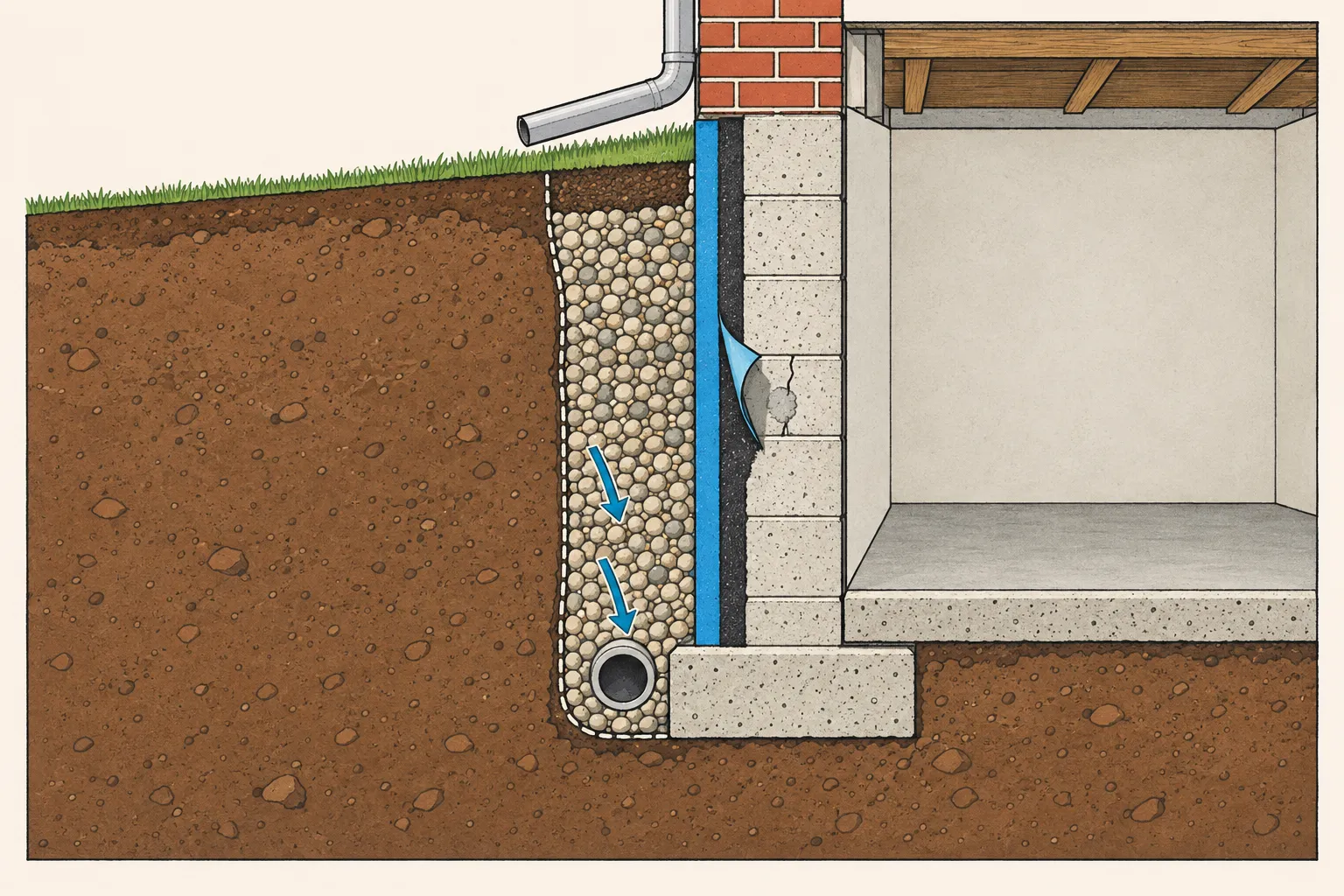
Warren basements take on water because the city was built fast in the 1950s and 1960s on flat ground that its engineer says is mostly heavy clay, which lets little water soak in. A city press release said the Aug. 11, 2014 flood damaged nearly 40% of Warren homes. Clark Basement Waterproofing, founded in 1956, waterproofs Warren foundations from the outside, dug by hand, with new drain tile and a written 10–15 year warranty; the length depends on the job.
Why do Warren’s 1960s basements leak?
Three things stack up here: a generation of houses built in a hurry, heavy clay, and ground so flat that water has nowhere to run. The city’s 2021 Master Plan says Warren’s population doubled in the 1950s and doubled again by 1970. In the 2020–2024 American Community Survey, 58.1% of Warren’s 57,958 housing units date from 1950 through 1969 and 83.4% predate 1980. The median year built is 1965, a decade older than Macomb County’s 1975.
In a 2011 memo to property owners, the city’s engineer called Warren extremely flat and said most of it sits on heavy clay that lets little or no water seep in. The same memo says most neighborhoods went in during the ’60s and ’70s, when developers had to install just one rear-yard catch basin for every eight lots.
USDA’s soil survey for Macomb County tells the same story. The soil mapped most often in the city, Lenawee silty clay loam, formed in lake-bottom deposits, and USDA’s series description notes frequent ponding between November and May. Measured inside the city limits, about four-fifths of Warren’s mapped soil is rated “Very limited” for dwellings with basements, chiefly for ponding and a high wet zone. Even the sandy pockets are wet underneath: Selfridge loamy sand, the third most common soil, is sand over loamy till, with a seasonal water table 1 to 2 feet down.
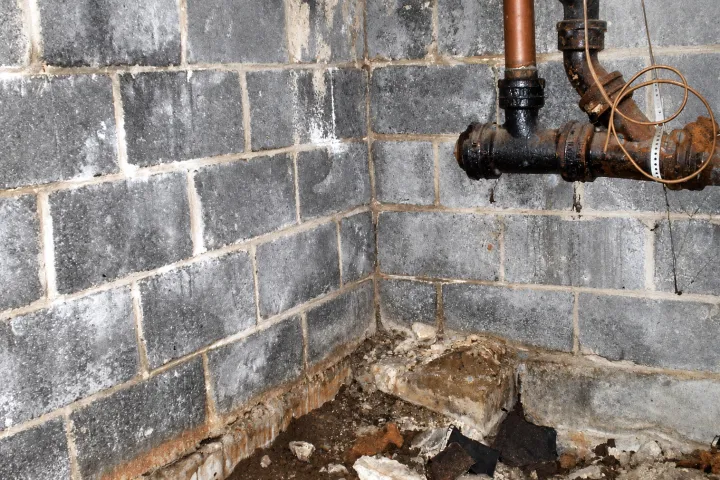
A 1960s foundation has now spent about 60 years in that ground. Saturated soil presses its water against the wall, roughly 437 pounds per square foot at the base of a 7-foot wall (USGS water density), and that pressure finds every crack and joint. Here is why wet clay pushes water through walls, especially at the thaw.
South of I-696 or north of it: what your ZIP code shows
The Master Plan describes smaller, older homes along the Detroit border, larger post-war lots farther north, and I-696 as the informal line between the two. Census and FEMA numbers by ZIP code follow that split:
| ZIP | Median year built | Built before 1960 | FEMA sign-ups per 100 homes, 2014 |
|---|---|---|---|
| 48089 (south) | 1962 | 46.4% | 15.7 |
| 48091 (south) | 1964 | 41.7% | 14.3 |
| 48088 (north) | 1966 | 14.3% | 13.9 |
| 48093 (north) | 1967 | 23.4% | 6.4 |
| 48092 (north) | 1967 | 24.6% | 4.7 |
The two south-end ZIPs, with the oldest housing, also led after the June 2021 and August 2023 storms, though the 2023 declaration also covered tornado and wind damage.
Sewer or groundwater: what flooded Warren basements in 2014 and 2024?
It can be either, and the city’s reports don’t say which. Each needs a different fix. If dirty water came up through the floor drain, the sewer backed up. That is plumbing: ask a licensed plumber about a backwater valve, a $10 item on Warren’s plumbing permit application. If it ran down a wall, came through a crack or seeped in along the base of the wall, groundwater got through the foundation, and exterior waterproofing is the fix. Here is how to tell a backup from seepage.
The two are linked in Warren. The city’s own sewer-responsibility drawing shows footing drains around the house tied into the house sanitary sewer lead, and the same handout asks owners to extend downspouts to cut the water running into those footing drains. In an older house plumbed like that drawing, the water the original footing drain collects heads down the same pipe as the sewage.
On Jan. 26, 2024, overnight rain on saturated ground flooded basements across the city, and Warren said its storm and sewer basins were at capacity. On Aug. 1, 2024, the city estimated about 2 inches of rain in an hour on the south end and at least 3 on the north end, and said its roughly 70-year-old infrastructure was built for rain events of 2 inches or less. A 1974 storm plan had already found trunk storm sewers with, on average, 50% or less of the capacity a 10-year storm needs (2023 Storm Water Management Plan).
Measured by FEMA aid applications, the worst of the recent storms was Aug. 11, 2014. A city press release said nearly 40% of Warren homes were damaged. FEMA logged 6,527 valid assistance registrations from Warren (OpenFEMA, pulled Sept. 27, 2026), 59% of all registrations in Macomb County, although the city holds only about one in six of the county’s homes. Only 230 of those registrants had flood insurance, and the city’s sewer handout warns that most homeowner policies do not cover sewer backups. Before you file, read how Michigan policies treat seepage, backups and floods.
Warren’s roughly $95 million sanitary overflow program added relief sewers, including a 4-foot line under 9 Mile Road, and ends with the 22-million-gallon Stephens Road Detention Basin for the 9 Mile sewer area. That work targets backups and overflows. None of it changes how hard wet clay pushes on your foundation wall.
What’s on Warren’s permit form, and what other rules apply?
Warren’s plumbing permit application even has a “Basement Waterproofing” line. Here is what the city publishes. We pull the permits the job needs ourselves.
| Topic | What Warren says |
|---|---|
| Plumbing permit | The 2025 plumbing permit application lists “Basement Waterproofing” as its own $80 line, next to backwater valve ($10) and sump and sump pump ($25). The total fee must be at least $80. |
| Work without a permit | The city’s list of work that needs permits, posted in 2019, warns that doing work without permits may bring fines up to $1,000. |
| Downspouts | City Code §41-65 bans any downspout leading to a sanitary sewer; the owner must fix it at their own expense. The city’s rain preparedness page also advises sending downspouts 5 feet from the foundation. That is advice, not code. |
| Regrading | Since 2022, City Code §32-26 requires the city engineer’s written permission to add, remove or regrade soil in a way that impedes or significantly changes the existing drainage pattern. |
| Sewer connections | Any sanitary or storm sewer connection needs a sewer connection permit (§41-63), and a new tie-in to a public storm sewer needs the public service director’s approval first (§41-140). |
| Before digging | The city’s Water and Sewer page says to call MISS DIG three working days before digging. MISS DIG does not mark private lines such as sprinklers or a line to a detached garage. We call MISS DIG 811 before every job. |
Which items on Warren’s flood checklist can Clark handle?
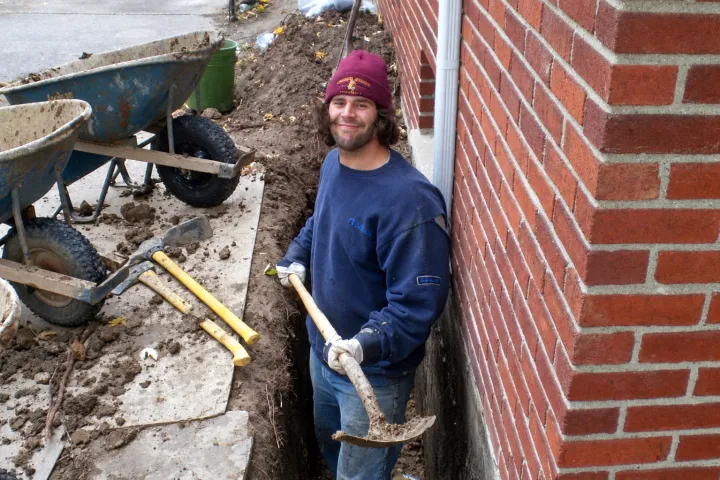
The wall, the cracks and the ground around them. Warren’s rain preparedness page tells homeowners to seal foundation cracks, regrade soil away from the house and send downspouts 5 feet out. Clark’s crews work those problems from outside the house only, digging by hand:
| Service | Where it fits in Warren |
|---|---|
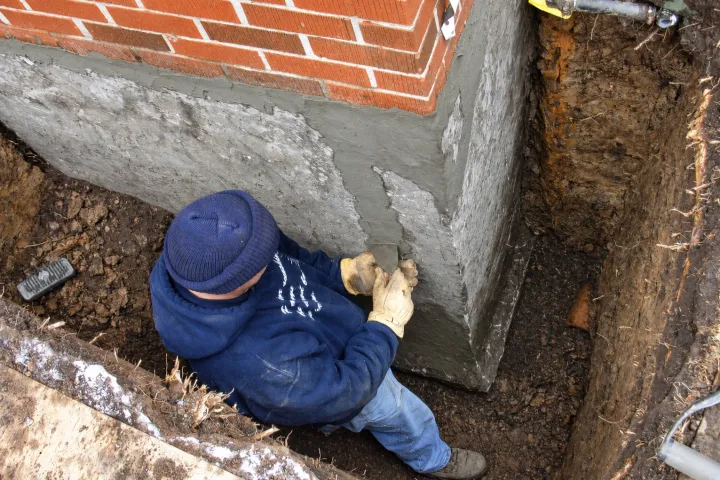
| Foundation crack repair | “Seal foundation cracks” is on the city’s list. Clark seals them with hydraulic cement on the outside face, where the water gets in. |
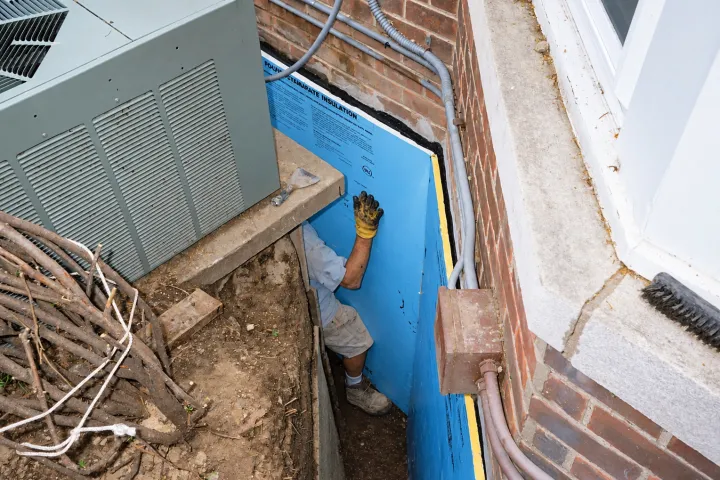
| Exterior basement waterproofing | For the 1950s and 1960s walls that seep after a soaking rain or the thaw: hand-dug to the footing, cracks closed, the wall tarred, a membrane on top. |
| Exterior water management | Covers the city’s regrading and 5-foot downspout advice, within §32-26’s limits on changing drainage. On a flat Warren lot, sometimes that alone dries a basement. |
| Drain tile replacement | Fresh tile bedded in pea stone gives water in the clay an easy path away from the footing. Where it drains depends on your house and the city’s rules; Mark will show you where the water will go during the estimate. |
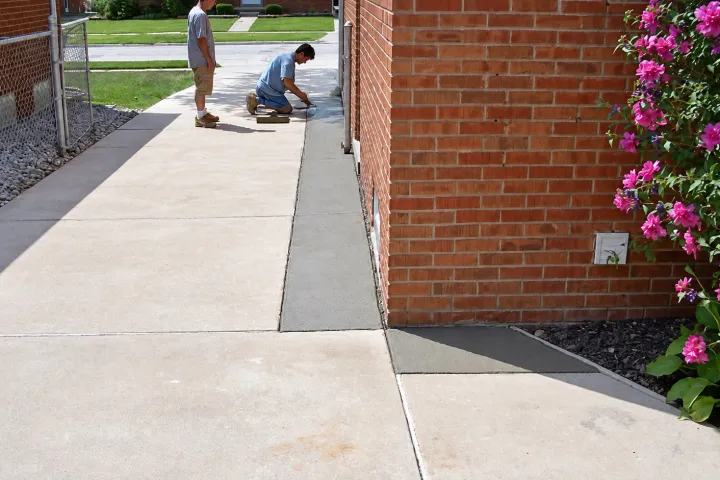
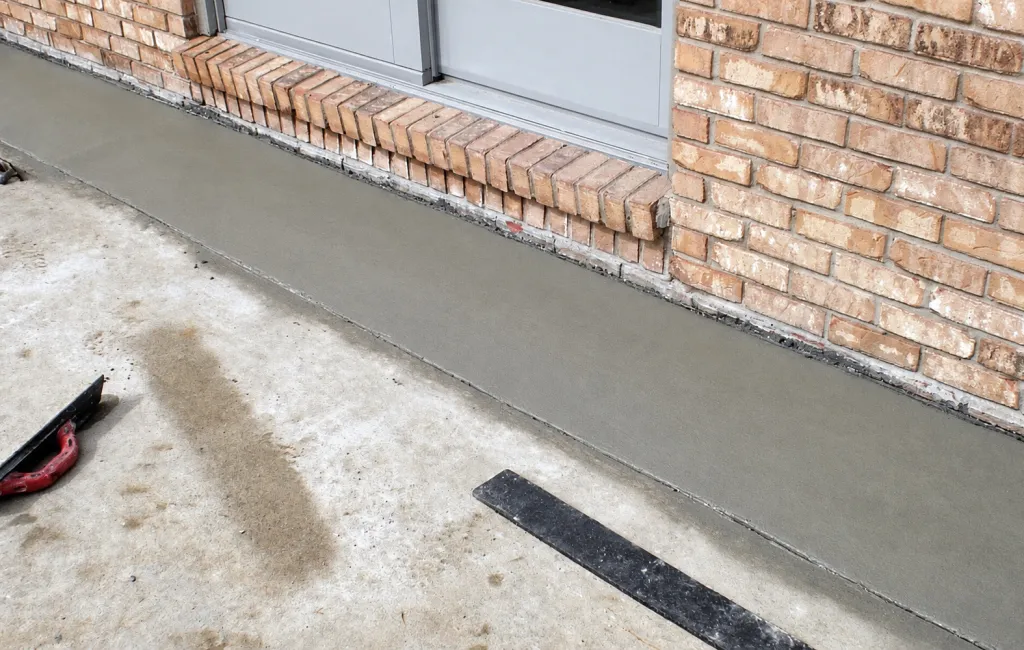
| Waterproofing under porches, decks and concrete | When a driveway, stoop or patio slab covers the wet wall, the slab is cut, the wall is done by hand and new concrete goes back in. |
| Basement leak diagnosis | After a night like Jan. 26, 2024, the free estimate begins by telling a floor-drain backup apart from wall seepage. |
Much of the rest of the city’s list is plumbing. Floor-drain backups, backwater valves and cracked sewer laterals are plumber’s work, and the city’s sewer handout makes the lateral to the main the owner’s responsibility. A bowing or shifting wall needs a structural engineer first. Clark does not install interior drainage systems.
A slab against the house doesn’t rule out an exterior job. Warren’s building details, like Michigan’s code, put footings at least 42 inches below grade, so the trench runs deep, and the concrete is replaced when the wall is done.
Warren is part of the area Clark Basement Waterproofing serves, along with St. Clair Shores, the Grosse Pointes and the rest of Macomb County. Clark is a family-owned company founded in 1956. Walk through a Clark job from the first shovel to the restored yard, or book a free estimate at your house.
Warren by the numbers
- The median Warren home was built in 1965, a decade older than Macomb County’s 1975 median (American Community Survey 2020–2024). Source data.census.gov (opens in a new tab)
- Of Warren’s 57,958 housing units, 83.4% were built before 1980 and 58.1% from 1950 through 1969 (ACS 2020–2024). Source data.census.gov (opens in a new tab)
- South Warren ZIP 48089 has a median build year of 1962, against 1967 in north Warren’s 48092 and 48093 (ACS 2020–2024). Source data.census.gov (opens in a new tab)
- The city engineer’s 2011 memo calls Warren extremely flat and says most of it sits on heavy clay that lets little or no water seep in. Source cityofwarren.org (opens in a new tab)
- The city engineer’s 2011 memo says most Warren neighborhoods were built in the 1960s and 1970s with one rear-yard catch basin for every eight lots. Source cityofwarren.org (opens in a new tab)
- About four-fifths of Warren’s mapped soil is rated Very limited for dwellings with basements, mainly for ponding and a shallow wet zone (USDA SSURGO, queried Sept. 2026). Source websoilsurvey.nrcs.usda.gov (opens in a new tab)
- Lenawee silty clay loam, common across Warren, formed in lake deposits and is frequently ponded from November to May, per USDA. Source soilseries.sc.egov.usda.gov (opens in a new tab)
- The city’s sewer-responsibility drawing shows house footing drains tied into the house sanitary sewer lead. Source cityofwarren.org (opens in a new tab)
- Warren’s 1974 storm master plan found trunk storm sewers had, on average, 50% or less of the capacity a 10-year storm needs. Source cityofwarren.org (opens in a new tab)
- Warren’s roughly $95 million sanitary overflow program ends with the 22-million-gallon Stephens Road Detention Basin, sized for the 9 Mile sewer area. Source cityofwarren.org (opens in a new tab)
- Warren’s 2025 plumbing permit application lists Basement Waterproofing as its own $80 line; a plumbing permit must total at least $80. Source cityofwarren.org (opens in a new tab)
- City Code §41-65 prohibits downspouts leading to a sanitary sewer, and owners must correct them at their own expense. Source library.municode.com (opens in a new tab)
- Since 2022, regrading that significantly changes a lot’s drainage pattern needs the city engineer’s written permission (City Code §32-26). Source library.municode.com (opens in a new tab)
- A City of Warren press release said the Aug. 11, 2014 flood damaged nearly 40% of Warren homes. Source cityofwarren.org (opens in a new tab)
- FEMA logged 6,527 valid registrations from Warren after the 2014 storm, 59% of Macomb County’s; only 230 had flood insurance (OpenFEMA, pulled Sept. 2026). Source fema.gov (opens in a new tab)
- On Jan. 26, 2024, rain on saturated ground flooded basements across Warren, and the city said its storm and sewer basins were at capacity. Source cityofwarren.org (opens in a new tab)
- On Aug. 1, 2024, the city estimated about 2 inches of rain in an hour on the south end and at least 3 inches on the north end. Source cityofwarren.org (opens in a new tab)
- Only about 1.6% of Warren’s land lies in FEMA’s high-risk 1%-annual-chance floodplain, along the Red Run and Bear Creek drains (FEMA flood map data, computed Sept. 2026). Source msc.fema.gov (opens in a new tab)
Neighborhoods we serve in Warren
- South Warren
- North Warren
- Patriot Place District
- Warren Village Historic District
Updated