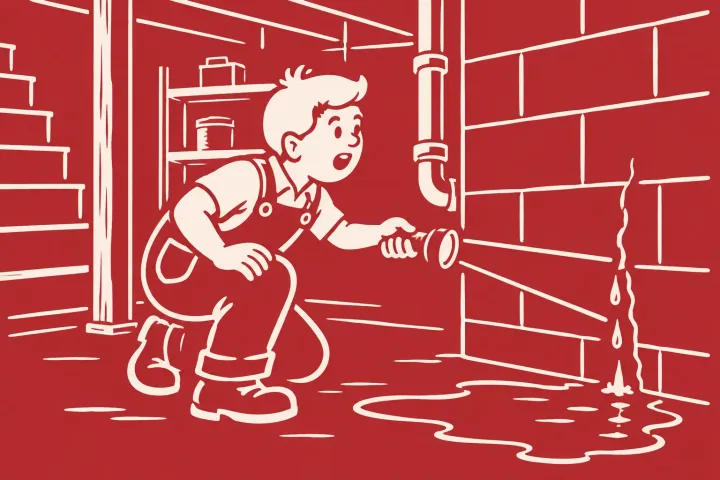
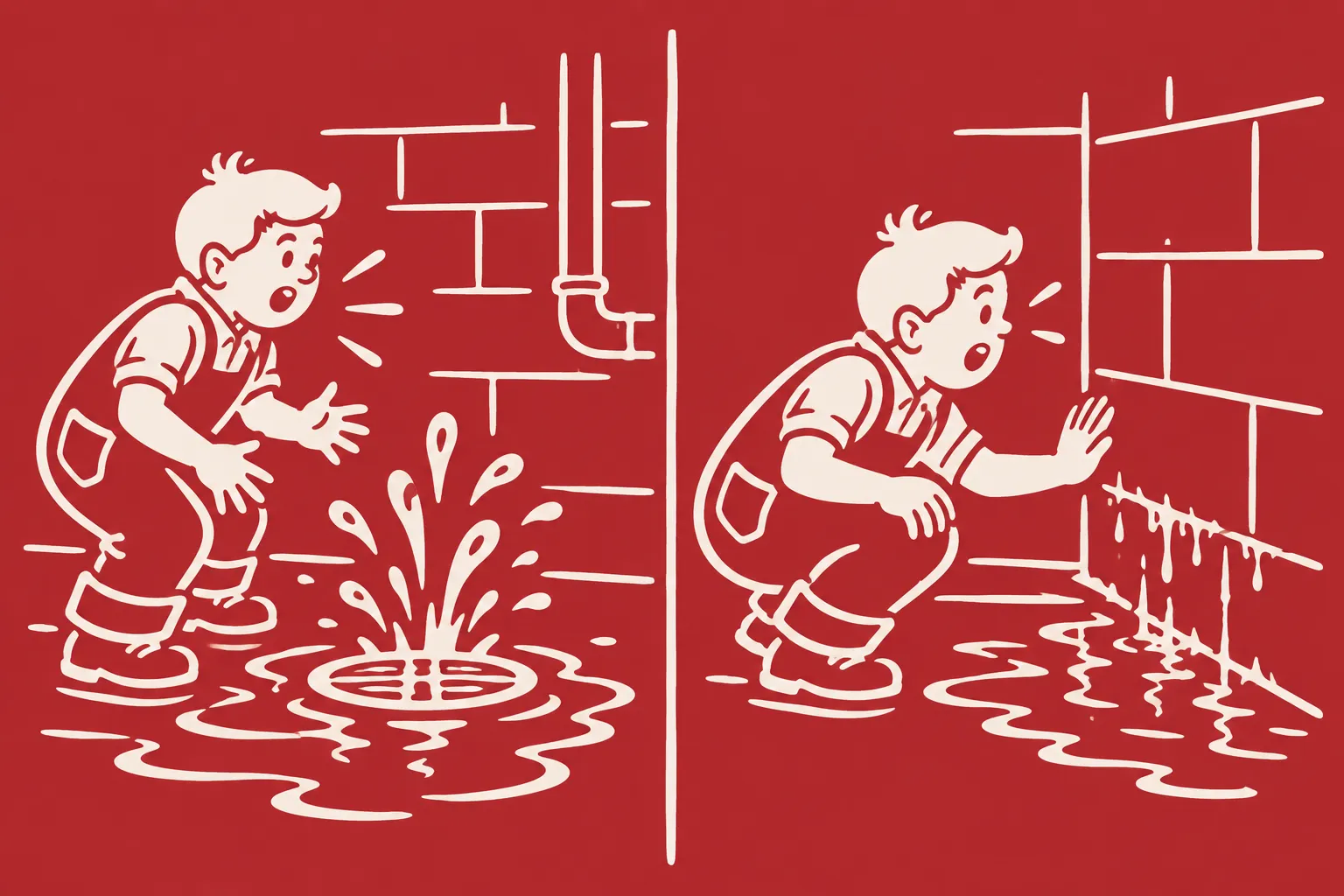
In Metro Detroit, water that rises through a basement floor drain during a heavy storm is most likely a sewer backup, which is a plumbing and sewer-system problem. Water that comes in at the floor-wall joint, through a crack or down a wall is seepage, the problem exterior waterproofing fixes. Many of the area's worst basement floods, including June 2021, were sewer backups. A sewer-backup claim against your city needs written notice within 45 days of finding the damage.
Two kinds of water flood basements in Metro Detroit, and on the floor they look alike. One comes up out of the sewer. The other soaks through the foundation from the ground outside. They have different causes, fixes and people to call, so the first job after a wet basement is working out which one you had.
Clark Basement Waterproofing does exterior work only: we dig by hand to the footing and stop groundwater outside the wall. That fixes seepage, not sewer backups, and this guide covers the local rules and claim deadline that apply where we work.
How can you tell a sewer backup from seepage?
Look at where the water came in and when. Water that rose out of a floor drain, especially during a downpour, is most likely a sewer backup. Water that came through a wall, a crack or the joint where the wall meets the floor is seepage.
| Clue | Sewer backup | Seepage |
|---|---|---|
| Where the water comes in | Up through the floor drain, or out of the lowest toilet, shower or laundry-tub drain | Through a wall crack, at the floor-wall joint, down the face of the wall or around a pipe |
| What it looks and smells like | Gray or brown water that smells of sewage and can leave grit or debris behind | Clear or muddy water with no sewage smell. It can leave a white, chalky salt crust on the wall as it dries |
| When it happens | During or right after an intense downpour, while the sewer is full | During heavy rain, snowmelt or a long wet spell, when the soil against the wall is soaked |
| Who else is wet | Neighbors on the same sewer often flood the same night | Often just your house, and often the same wall each time |
| Who to call | Your city’s public works department to report it, then a licensed plumber | An exterior waterproofing contractor. A structural engineer first if a wall bows or a crack runs sideways |
St. Clair Shores’ flood newsletter defines backflow as the contents of the storm or sanitary pipes flowing the wrong way, into the basement. Seepage is groundwater: saturated soil builds pressure that, in the words of a Building Science Corporation report for the U.S. Department of Energy, “will push water through any available joints, imperfections, or cracks in the foundation.” The white crust is efflorescence, salt left behind as that water dries.
If sewage is on the floor, deal with the power first. St. Clair Shores tells residents to have the utility shut off gas and electricity, not to touch the fuse box or anything plugged in until the power is off, and to keep children out during cleanup. Warren’s rain preparedness page also advises cutting power to a wet basement. Then photograph the damage before you clean; a claim will need it.
Why do basements back up in big storms?
Because the sewer fills faster than it can drain. When a storm sends more water into the pipes than they, and the pump stations downstream, can carry, the water backs up toward the lowest openings it can find. In a house with a basement, that’s usually the floor drain.
Combined sewers make this more likely. They carry sewage and storm water in the same pipe, so every downpour lands in the line your basement drains into. Separated systems keep street water in its own pipes, but rain still gets into sanitary lines through cracked pipes, footing drains and old downspout connections. That is why cities from St. Clair Shores to Warren bar downspouts from the sanitary sewer.
The Great Lakes Water Authority’s preliminary investigation of the June 2021 storms found that basement flooding can come from restrictions in local sewers, from the capacity of the big regional trunk sewers, or from both. Those were preliminary findings. GLWA’s final report in June 2022 found the rain exceeded the system’s design capacity in some areas, and that some backups may have come from problems in local or private sewer lines.
Pump stations matter too. Grosse Pointe Farms counted 288 flooding calls, all residential, after the May 25, 2011 storm, which its engineer said was more than the combined sewers and the Kerby/Chalfonte pump station could handle at the peak (June 2011 council minutes). After June 2021, the Grosse Pointe News reported a GLWA finding that reduced pumping at the Freud station and a power loss at Connors Creek, both in Detroit, may have made flooding worse. The final report also found that backup risk would not have dropped appreciably even if everything had worked as intended, and named sewer capacity, not pumping, as the primary cause.
None of that involves your foundation walls. Digging outside and sealing them won’t keep a full sewer from pushing water up your floor drain.
How do the sewers work in your city?
Each city runs its own system, and the differences shape the backup risk on your street. Here is the short version for the cities Clark serves.
| City | Sewer system | Worth knowing |
|---|---|---|
| St. Clair Shores | Mostly separated, but about 1,478 acres in three districts, mostly on the south end, are still combined (city map) | Macomb County said in October 2023 that the 8½ Mile Relief Drain district downstream handles combined flow from about 80% of the city (county release). The Master Plan records hundreds of basement backups in the July and August 2016 storms. |
| Grosse Pointe Park | Built combined in the 1920s–1940s; separating since the mid-1990s and, the city says, close to 95% done (July 2025) | A last-resort relief valve that can pump the sanitary system to the lake has never been needed, the city said in July 2026. The Grosse Pointe News reported June 2021 backups of sewer and runoff water in about 3,000 Park homes and businesses. |
| Grosse Pointe Woods | Combined sewer, draining to Wayne County’s Milk River retention basin (city) | The Department of Public Works logged 264 flooded basements in 2021, against 16 in 2020 (2021 annual report). |
| Grosse Pointe Farms | Lakeside District separated in the early 2000s; the Inland District is combined, with partial separation under way (2021 council slides) | The city expects about one-third less wet-weather flow into the combined sewers (Mar. 2026 council packet), with the Inland work substantially complete by the end of 2027 (Aug. 2026 notice). |
| Grosse Pointe Shores | Separate sanitary and storm sewers (city code); sanitary flow goes to the Southeast Macomb Sanitary District | Downspouts had to come off the sanitary sewer by June 1998 (city code). |
| Warren, MI | City documents describe separate sanitary and storm sewers (storm water plan) | Relief sewers and the 22-million-gallon Stephens Road Detention Basin target basement flooding (city). A city sewer drawing shows footing drains tied to the house sanitary lead; Warren’s code also describes footing tile draining to a storm line through a sump, so which setup your house has varies. |
| Harrison Township | No combined-sewer district appears in township plans | The Master Plan says sanitary lines “are often impacted when major precipitation events overwhelm the system.” |
| Clinton Township | Separate sanitary sewer, sending flow to the county’s Macomb Interceptor | The township’s public services director told the Macomb Daily in 2019 that many older south-end homes have footing drains tied into the sanitary sewer, and that houses built after 1973 don’t; officials blamed those connections for the backups. |
Each linked city page covers local permits and flood history; our Grosse Pointes overview compares the Pointes.
Are your footing drains tied to the sewer?
In many older homes, yes, and it matters for backups. Footing drains, also called drain tile, run along the bottom of the foundation and collect groundwater before it pushes through the wall. In many older houses that water was piped into the same sewer lead as the toilets and the floor drain.
The cities say so themselves. Grosse Pointe Park’s 2022 infrastructure update noted that older homes commonly have basement drains tied to the outside drainage system, and warned that leaves and debris in old French drains can block the outside drainage and push water back up through floor drains. Warren’s sewer-responsibility drawing shows footing drains connected to the house sanitary lead; Warren’s code also describes footing tile draining to a storm line through a sump, so which setup your house has varies. In the Farms’ Inland District, the city’s consultant designed the new storm sewers to leave footing drains on the old combined pipes (Feb. 2021 council packet).
A footing drain on the sewer lead sends groundwater from around your house into the sewer in every storm. Several cities now bar them:
- St. Clair Shores: Code §42-23(g) bars connecting footing drains or downspouts to a building sewer that leads to a public sanitary or combined sewer.
- Grosse Pointe Park: §14-22 calls a footing drain on the sanitary sewer an illicit connection “regardless of whether” the city once allowed it.
- Harrison Township: §90-348 bans tying foundation drains to the sanitary sewer; seepage tile goes to a sump that discharges outside.
- Clinton Township: the township’s code, reproduced in its 2025 storm water plan, sends foundation drains on permitted basements to a storm sewer, storm drain or road ditch, never the sanitary sewer.

Replacing old tile? Our drain tile guide explains how footing drains work and fail, and drain tile replacement covers the job. Where new tile can drain depends on your house and your city’s rules; see the questions below.
What does a backwater valve do, and who installs it?
A backwater valve is a device in your house drain or sewer pipe that keeps sewage from backing up into a lower level or fixture, in the words of St. Clair Shores’ flood newsletter. It is plumbing work: call a licensed plumber, and expect a permit.
The Michigan Residential Code calls for backwater valves on plumbing fixtures whose flood-level rims sit below the manhole cover of the next upstream manhole on the public sewer (2015 MRC P3008.1). St. Clair Shores requires a permit and inspection for any plumbing work, and Warren’s plumbing permit application and Grosse Pointe Park’s fee schedule list backwater valves as permit items.
Order matters. Grosse Pointe Park says a footing drain connected to the sanitary lateral must be disconnected before a sanitary backflow device goes in, and it recommends plugging the floor drain when it isn’t in use. St. Clair Shores adds that a subsoil drain subject to backflow needs a backwater valve too.
GLWA’s list of short-term steps for homeowners with frequent basement flooding includes backflow preventers, sump pumps, sewer line cleanouts, basement sealing, yard grading and directing roof water away from the foundation. The last three deal with water coming through the walls, not up the drain. That is where exterior waterproofing and grading and downspouts come in. When we checked in September 2026, we found no backwater-valve rebate from St. Clair Shores, Grosse Pointe Park, Woods or Farms, Warren, Harrison Township or Clinton Township.
How do you file a sewer backup claim with your city?
Report the backup right away and put your claim in writing within 45 days. Michigan law (MCL 691.1419) requires written notice to the government agency within 45 days after the damage was discovered, including your name, address and phone number, the address of the damaged property, the date you found the damage and a brief description of the claim.
- St. Clair Shores: call the Department of Public Works (sewer) at 586-445-5363, then email the city’s Flood Claim Form to the Finance Department.
- Grosse Pointe Woods: the City Clerk posts a Notice of Claim form for sewer-backup claims.
- Grosse Pointe Shores: after the June 2021 storm, the city posted its notice of claim with the deadline spelled out: 45 days, or August 10, 2021.
- Harrison Township: the township tells residents to file a written claim within 45 days of discovering a backup.
- Anywhere else: ask your city clerk or public works department which form they use and where written notice goes.
One catch. Under MCL 691.1416, a backup isn’t a sewer system event the city answers for if a blockage in your own service lead that the city didn’t cause, or a connection on your property such as a sump system, building drain, surface drain, gutter or downspout, was a “substantial proximate cause,” which the law defines as 50% or more of the cause. This is general information, not legal advice. Insurance is a separate question: see what insurance covers.
What can exterior waterproofing fix, and what can’t it?
It fixes seepage: groundwater coming through the foundation walls, through cracks and at the floor-wall joint, and water that builds up against the wall because old drain tile no longer carries it away. It can’t fix a sewer backup, a plumbing leak or condensation from humid air, and a wall that bows inward needs a structural engineer before anyone seals it. For when an interior system makes more sense, read interior vs. exterior waterproofing.
Clark stops seepage where it starts, on the outside of the wall. The crew digs by hand to the footing, seals cracks with hydraulic cement, applies a tar coating and a waterproof membrane, lays new drain tile in pea stone, then backfills and restores the yard. A typical job takes 3 to 7 days. We call MISS DIG 811 before every job and pull the permits the job needs ourselves. See how the process works, or read why wet soil pushes so hard in our guide to hydrostatic pressure.

What if your basement had both?
Fix each one on its own terms. The storm that fills the sewer also soaks the soil against your walls, so a basement can take a backup through the drain and seepage through a wall in the same night. A backwater valve won’t stop the wall leak, and waterproofing won’t stop the backup.
Start with what you saw. Water from the drain: report it to the city, get your written notice in within 45 days and call a plumber. Water through a wall or at the floor-wall joint: that part is ours. Tell us about the backup too, so we see the whole picture at the estimate. Clark serves St. Clair Shores, the Grosse Pointes, Warren and Macomb County. Estimates are free, written and on site, and we call back within a day. Start with basement leak diagnosis or request a free estimate.