Clark Basement Waterproofing digs every exterior waterproofing job in Metro Detroit by hand, with no backhoes. Hand digging fits the narrow side yards, porches, driveways, mature plantings and buried lines around older homes, and it limits damage to landscaping. A machine can move soil faster on an open lot. Hand work takes more labor, but it reaches places a machine cannot, and most Clark jobs take 3 to 7 days.
Every Clark Basement Waterproofing job is dug by hand, with shovels and wheelbarrows and no backhoes. That choice shapes where we can work, how long a job takes and what your yard looks like afterward.
This guide compares hand digging with machine excavation for exterior waterproofing: what each does well, where a machine can’t go, how buried utility lines are handled, what hand work costs in time and when a machine is the better tool. We’ll be straight about the trade-offs, including the ones that don’t favor us.
How do hand digging and machine excavation compare?
Both get to the same place: the footing at the bottom of your basement wall. A machine moves soil faster where it has room to work. Hand digging is slower, but it fits where a machine can’t and disturbs less of the yard around the trench.
| Hand digging | Machine (backhoe or mini excavator) | |
|---|---|---|
| How the soil comes out | Shovels and wheelbarrows, with the crew working along the wall | A bucket on a hydraulic arm |
| Room it needs | Enough for a person to work in the trench | A path in from the street or driveway, plus room to swing the arm and pile the soil |
| Lawn and landscaping | Disturbance stays mostly in the trench and where the soil is piled | The trench and pile, plus the machine’s path across the yard |
| Buried lines near the wall | Hand digging is one form of soft excavation, which Michigan law requires to expose marked lines within 48 inches of a mark | Within 48 inches of a utility mark, the lines must be exposed by soft excavation before the machine digs there |
| Speed | Slower, with more labor per foot of wall | Faster at moving soil on open ground |
| Trench safety rules | Michigan’s MIOSHA trench rules apply | The same MIOSHA rules apply |
| The waterproofing itself | Hand work | Still hand work; the machine only digs |
| Best fit | Side yards, walls behind porches and driveways, planted beds, crowded lots | Open lots with clear access and nothing in the way |
The honest trade-off is time and labor against access and disturbance. On an open lot with clear access to the wall, a machine gets the digging done sooner. The real question is what stands between the street and your wall: a neighbor’s house a few feet away, a porch, a driveway, a gas meter or a row of shrubs.
Where can’t a machine dig?
Anywhere it can’t drive to, reach into or swing its arm. A backhoe or mini excavator needs a way in from the street or driveway, solid ground to sit on and room beside the trench for its bucket and the soil it lifts out. The wall that leaks may be exactly where none of that fits:
- Side yards between houses, where the gap to the neighbor’s wall can be only a few feet.
- Walls behind porches, stoops, decks, patios and driveways. Clark cuts the concrete, digs and waterproofs the wall by hand, and replaces the concrete when the work is done (see waterproofing under porches, decks and concrete).
- Walls next to air conditioners, gas and electric meters and the lines that feed them.
- Planted beds, mature shrubs and trees you want to keep.
- Back yards behind fences, gates or a garage, with no way to drive in.
On one job, the wall that needed work ran along a side yard, with a fence a few feet from the house.
I couldn’t dig here with the machine if you wanted to.
Mark Rhoades, owner
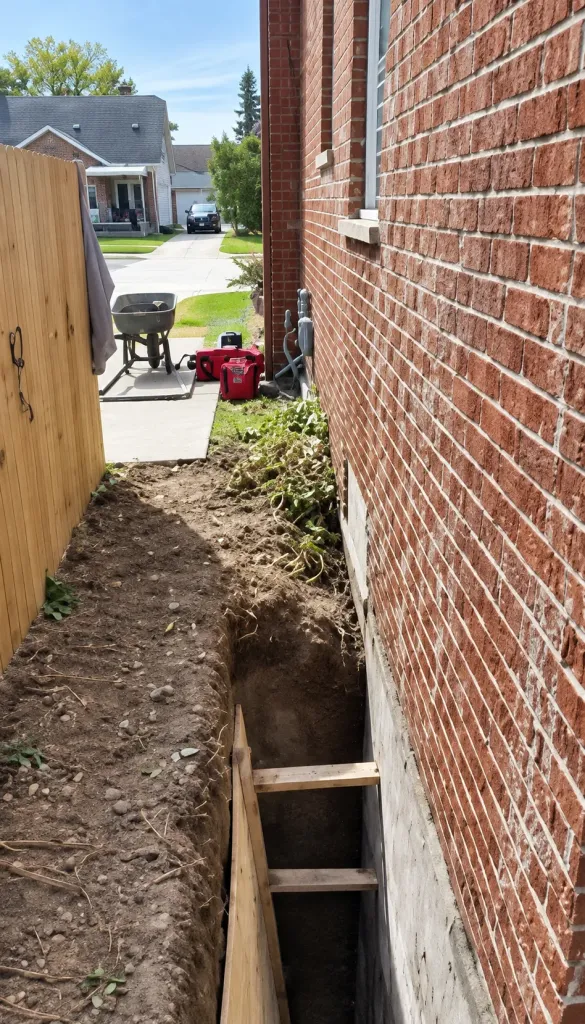
Digging by hand also means anything buried near the wall, like a pipe, a cable or a large root, is uncovered with a shovel rather than a bucket. That matters most right along the house, which is where the next two questions come in.
How deep does the digging go?
Down to the footing, the concrete base the basement wall sits on. The whole wall has to be exposed so it can be sealed and coated from top to bottom, and so new drain tile can be laid beside the footing.
Michigan’s residential code requires footings to extend at least 42 inches below grade (2015 Michigan Residential Code, R403.1.4; the 2015 code remains in force while the 2021 update is on hold pending litigation, checked September 2026). A basement footing sits at the bottom of the basement wall, so the trench goes deeper than that. Hand digging doesn’t mean a shallow dig. It means the same depth, reached with a shovel.
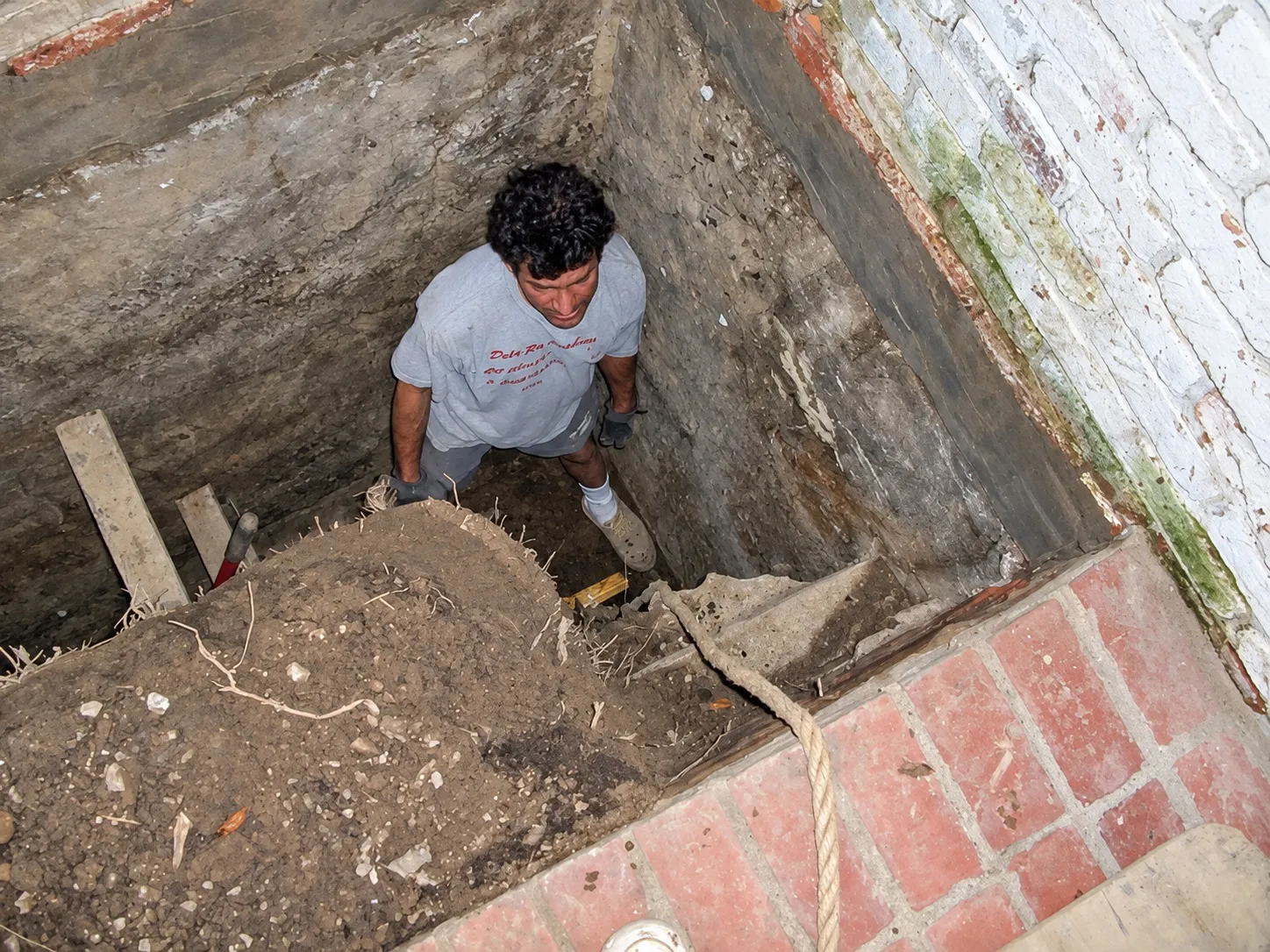
Depth also brings safety rules, whatever does the digging. In Michigan, trench safety on construction jobs falls under MIOSHA, the state’s own OSHA program. Its excavation standard (Construction Safety Standard Part 9, Rule 941) requires the sides of an excavation more than 5 feet deep to be sloped or supported, for example with shoring. Shallower trenches must be protected too when the ground shows signs it could move. Federal OSHA’s rule draws the same 5-foot line (29 CFR 1926.652).
Building Science Corporation’s foundation guidance for the U.S. Department of Energy says the same about exterior foundation work: locate the buried services first, and dig with OSHA-approved methods.
How does hand digging protect gas lines and other buried utilities?
By uncovering them with a shovel instead of a bucket. MISS DIG 811 says it must be contacted at least 3 business days before any digging project, whatever its size or depth, and state law says notice can’t be given more than 14 calendar days before excavation starts. The utilities then come out and mark their lines. The strip within 48 inches of either side of a mark is called the caution zone. There, marked lines have to be exposed by soft excavation, which includes hand digging, before any power equipment is used (MCL 460.723 and 460.725).
A foundation trench runs right along the house, where gas, electric and other service lines come in to their meters. With hand digging, any line along the wall is uncovered with a shovel, the same kind of soft excavation the law requires for exposing marked lines in the caution zone. We call MISS DIG 811 before every job.
Hand digging doesn’t replace the call. A MISS DIG 811 handout posted by the Grosse Pointe Shores Building Department warns that “even hand digging can cause damage.” And not everything gets marked:
- Utilities mark the approximate location of their lines, not how deep they are.
- Private lines aren’t marked. That includes sprinkler systems, invisible dog fences and lines to a detached garage, shed, pool, grill or lamp post.
- Water and sewer lines are often marked only in the public right-of-way, not all the way to the house.
If you know of anything buried near the house that the utilities won’t mark, tell us at the estimate. It takes a minute and saves a lot of trouble.
How is the yard protected during a hand dig?
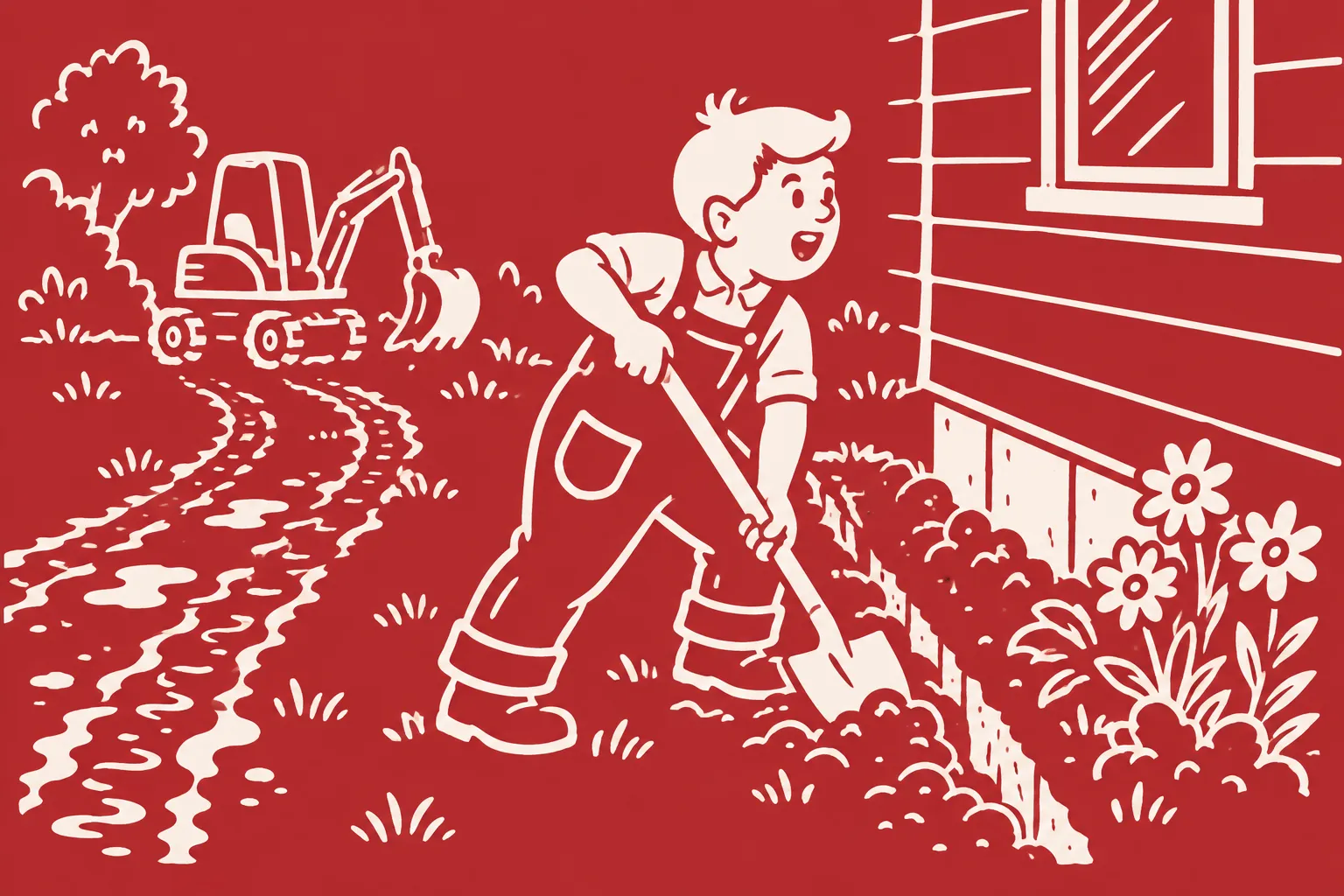
By keeping the work in a narrow strip along the wall and covering what’s next to it. There’s no machine crossing the lawn. Soil comes out by shovel and moves by wheelbarrow, and plywood can go down over grass and walks so wheels and boots don’t chew them up.
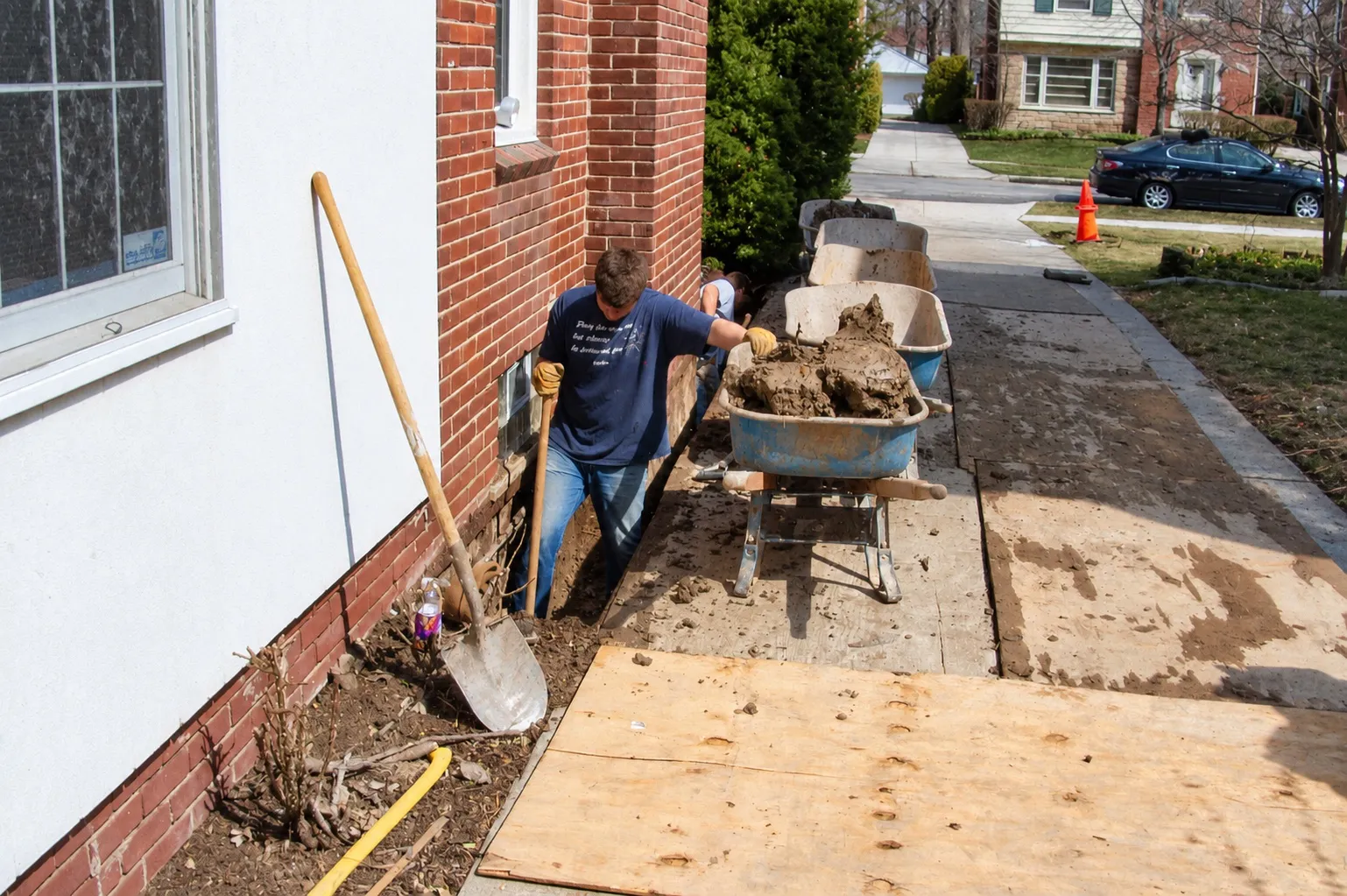
Shrubs along the foundation don’t automatically come out; usually the crew works around them. On one job the bushes along the wall did come out, because the homeowner wanted them gone.
If there are plants you care about near the wall, point them out at the estimate so the plan for the trench accounts for them.
When the waterproofing is done, the trench is backfilled and the yard is restored. Any walk, patio or driveway that had to be cut is replaced, and Clark’s own crew pours the new concrete.
Be realistic about one thing. Any exterior dig disturbs the ground along the wall. Building Science Corporation says repairing a failed foundation drainage and waterproofing system is “destructive to exterior landscaping.” Hand digging doesn’t make that zero. It keeps the damage as close to the wall as we can.
Is hand digging slower?
Yes, foot for foot. A crew with shovels moves soil more slowly than a machine on open ground, and hand work takes more labor. Even so, most Clark jobs take 3 to 7 days from start to a restored yard.
Where a job lands in that range depends more on the house than on the shovel:
- How much wall is being dug: one side, several or the whole house.
- How deep the footing is.
- Whether a porch, walk, patio or driveway has to be cut out and replaced.
- What the crew finds at the wall, such as cracks to seal or old drain tile to replace.
- Weather. We don’t dig when the ground is frozen.
A machine only speeds up moving soil. Sealing cracks with hydraulic cement, coating the wall with tar, putting on the membrane and laying drain tile are hand work on any job. Our process page walks through a Clark job step by step.
Does hand digging cost more?
It takes more labor per foot of wall, but that alone doesn’t settle the price. On a tight lot a machine may not be an option at all, and anything a machine crosses or tears up on the way to the wall has to be repaired. Which approach comes out ahead depends on the house.
We don’t publish prices. What drives the cost of any exterior job is the same list that drives the schedule: how much wall, how deep, what’s in the way, what shape the wall and the drain tile are in, and what has to be restored afterward. Estimates are free, written and done on site, and we call back within a day. Ask for the price and the schedule together. Request a free estimate.
When does a machine make sense?
When there’s room for it and little in the way. A machine is a reasonable choice on an open lot with clear access to the wall, no porch or driveway against it, no plantings you want to keep and a yard you don’t mind having crossed. New construction, before any landscaping goes in, is the obvious case.
Clark doesn’t dig with machines, so if your house sits on a wide-open lot and speed matters most, a contractor who digs with a machine may finish the digging sooner. That’s a fair trade-off to weigh.
Local rules can come into it too. Grosse Pointe Shores limits the hours when bulldozers and other mechanized earth-moving equipment may run (City Code Sec. 10-62). Some cities set hours for any digging, by hand or by machine: Grosse Pointe Park limits construction work, including excavation, to 7 a.m. to 6 p.m. on weekdays unless the City Manager grants a permit (City Code Sec. 28-226).
And sometimes neither kind of digging is the answer:
- If downspouts or grading send water toward the wall, fixing those may be enough. Building Science Corporation notes that many basement water problems can be solved with grading and surface drainage. See exterior water management.
- If water came up through a floor drain, it was most likely a sewer backup, which exterior waterproofing doesn’t fix. See sewer backup vs. seepage.
- If a wall truly can’t be reached from outside, interior drainage to a sump is the usual alternative. Clark doesn’t install interior systems. Interior vs. exterior waterproofing compares the two.
Why does Clark dig every job by hand?
Mark’s reasons are the two in his own words above: no machinery to tear up your landscaping, and places a machine can’t reach. Clark was founded in 1956, and older foundations under 1920s to 1970s homes are our specialty. Houses like these often have porches, tight side yards and decades of landscaping around the walls.
Mark Rhoades, who has more than 40 years of hands-on waterproofing experience, is on site at the key stages of every job, and the digging is done by Clark’s own crew, not subcontractors. Every job follows the same order: hand dig to the footing, seal cracks with hydraulic cement, apply a tar coating and a waterproof membrane, lay new drain tile in pea stone, then backfill and restore the yard. The work comes with a written 10–15 year warranty; the length depends on the job (see our warranty). For the full service, see exterior basement waterproofing.