Most basement leaks in Metro Detroit come from one of five places: cracks in the wall, the joint where the wall meets the floor, failed drain tile, water pooling against the foundation from downspouts or grading, or a sewer backup through a floor drain. Where the water shows up and when it happens tell you which one. A sewer backup is a plumbing problem, not a waterproofing one.
A wet basement leaves clues. Water gets in by only a handful of routes, and each leaves its own pattern: where the water shows up, when, and what it looks like. Read the pattern and you’ll usually know whether you need a waterproofer, a plumber, a structural engineer or just a longer downspout.
Diagnosis comes first. The National Park Service’s guide to moisture in older buildings opens its list of principles with “Avoid remedial treatments without prior careful diagnosis.” Clark Basement Waterproofing works on the outside of the foundation only, so we’ll also tell you plainly when the fix isn’t ours.
Where is the water coming from?
Start with two questions: where does the water appear, and when? A Building Science Corporation report for the U.S. Department of Energy notes that timing (constant or seasonal) and location (near wet soil or a disconnected downspout outside) give clues to the cause.
| What you notice, and when | Most likely source | Where to start |
|---|---|---|
| Water below one wall near a downspout or low spot, during or just after rain | Roof or surface water soaking the soil against that wall | Downspouts and grading |
| Water where the wall meets the floor after long or heavy rain, or at spring thaw | Groundwater under pressure; drain tile not carrying it away | Drain tile and exterior waterproofing |
| Water from a crack in the wall after rain | Water in the soil finding the crack | Crack repair from outside; an engineer first if the crack is horizontal or the wall bows |
| Water on the wall behind a porch, patio or driveway after rain | Water collecting against a wall hidden by concrete | Waterproofing under concrete |
| Water up out of the floor drain in a big storm, maybe with grit or a sewage smell | Sewer backup | A plumber and your city (backup vs. seepage) |
| Clean water seeping up through floor cracks for days in wet seasons | Groundwater rising under the floor | An on-site look at the drainage |
| Damp walls or a sweating floor in humid weather, rain or not | Condensation | A dehumidifier |
| Water near the water heater, washer or pipes, in any weather | A plumbing leak | A plumber |
Why does my basement leak only when it rains?
A leak that starts during a rain and stops soon after usually comes from surface water: rain off the roof or the yard soaking the soil right against one wall. Look outside that wall first.
Roofs gather rain from a big area and, in Building Science Corporation’s words, “concentrate rainfall at points around the perimeter of the building.” A downspout that empties at the corner, an overflowing gutter, or a walk, patio or flower bed that slopes toward the house sends that water straight into the soil beside your foundation. St. Clair Shores’ public works department warns that a debris-filled gutter can cause basement leaks, and that planting beds near the house can create drainage problems.
The Michigan Residential Code calls for the ground to fall at least 6 inches within the first 10 feet from the foundation (2015 MRC R401.3), and the same report warns that settling backfill can leave the ground sloping toward the wall. This is often the least expensive kind of leak to fix: “many problem cases can be solved with grading and surface drainage,” the report says. See exterior water management.
Why does it leak after heavy rain but not light rain?
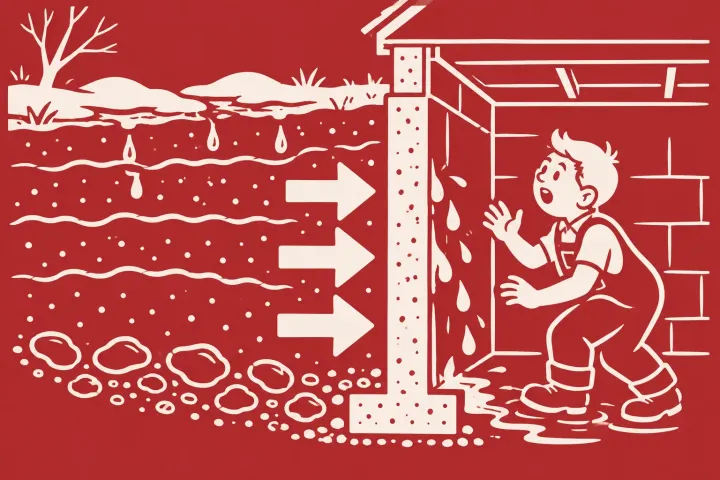
If your basement stays dry through ordinary showers but leaks after a long, soaking rain or a downpour, the soil around the foundation has filled with water faster than it can drain. That water presses against the wall and looks for a way in.
Clay makes this worse because it drains slowly, and USDA soil survey data map most of St. Clair Shores and the Grosse Pointes as somewhat poorly to very poorly drained. Water in saturated soil pushes on a wall with about 62 pounds per square foot for every foot of depth, roughly 437 pounds per square foot at the bottom of a 7-foot wall. Building Science Corporation says that pressure “will push water through any available joints, imperfections, or cracks in the foundation.” Our hydrostatic pressure guide explains the numbers.
Drain tile, the pipe or line of short clay tiles beside the footing, is there to carry that water away before it builds up. Detroit’s water department lists drain tile that isn’t maintained among the reasons basements flood. A basement that leaks in every big storm, and keeps seeping for a day or two afterward, may have drain tile that isn’t keeping up. See our drain tile guide.

Big storms test every basement. The National Weather Service measured 4.00 inches of rain in two hours at St. Clair Shores on July 28, 2025. In a storm like that, check the floor drain as well as the walls: heavy rain can also overload the sewer.
Why did my basement start leaking all of a sudden?
A basement that was dry for years and then leaks usually means something changed outside, or the leak isn’t as new as it looks. The usual suspects:
- The water moved. A downspout extension got knocked off, a gutter filled with leaves, or a new patio or garden bed slopes toward the house.
- A crack opened up. Water expands when it freezes (the U.S. Geological Survey notes ice is about 9 percent less dense than water), and Michigan’s code puts the frost line at 42 inches. A small crack in the upper wall can widen over several winters until it lets water through.
- The drain tile stopped keeping up. Building Science Corporation’s report allows for footing drains clogging over time, and tile can reach the point where it no longer carries a heavy rain away.
- The weather changed. A wall that held for years can leak in an unusual downpour or a fast thaw.
- It was leaking all along. Building Science Corporation warns that interior finishes and insulation can hide water problems “for extended periods of time,” until the damage is extensive.
Why is water coming in where the floor meets the wall?
Water along the base of the wall, at the seam where the concrete floor meets the foundation, usually means groundwater under pressure. When the soil fills with water down at footing level, that seam (often called the cove joint) is one of the easiest ways in.
A wet seam means water is building up outside and below the wall faster than it drains away. Water in contact with concrete and masonry can also wick through it (Building Science Corporation calls this capillarity), which is why the bottom of a wall can stay damp with no puddle.
Sealing the seam from inside doesn’t change what’s happening in the soil. The fix that deals with the cause is outside: drain tile at the footing that carries water away, and a sealed, coated wall above it. That is what exterior waterproofing and drain tile replacement do. An interior drain to a sump is the other approach; our interior vs. exterior comparison covers both.
Why is water coming up through the basement floor?
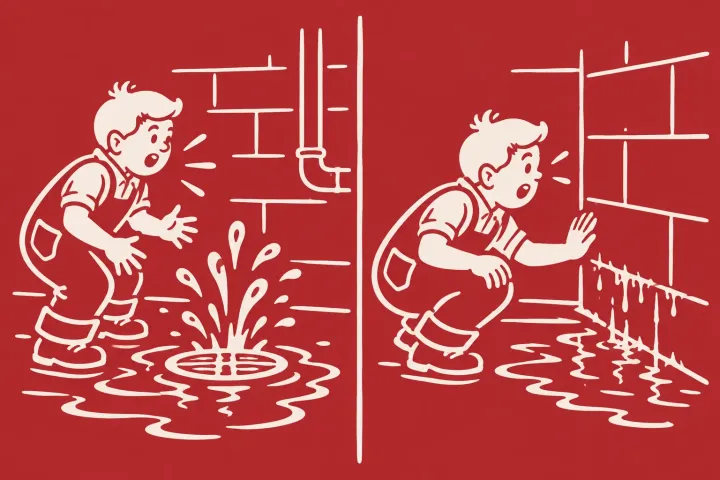
Look at exactly where it comes up. Water rising out of the floor drain, especially in a big storm and with grit or a sewage smell, is most likely a sewer backup. Clean water seeping up through floor cracks during a wet season is groundwater. They need different fixes.
A sewer backup happens when the sewer can’t take what’s being sent to it, or the line from your house fails. In the June 25–26, 2021 storm, the National Weather Service’s storm-total reports included 8.19 inches of rain at Grosse Pointe Park. The Great Lakes Water Authority’s preliminary investigation found that basement flooding can result from local sewer restrictions, the capacity of the larger trunk sewers, or both.
Exterior waterproofing does not stop a sewer backup. A licensed plumber can tell you whether a backwater valve makes sense for your house. If a public sewer backed up into your home, Michigan law requires written notice to the city within 45 days of discovering the damage to make a claim (MCL 691.1419). See sewer backup vs. seepage.
Groundwater coming up through the slab is a drainage problem. Footing drains, in Building Science Corporation’s words, “keep ground water levels from rising above the interior floor levels,” and water building up under a slab can push through joints and cracks in the floor. That calls for an on-site look at the drainage around the house. Clark does not install interior drainage systems.
Could it be condensation or a plumbing leak?
If the walls or floor get damp in muggy summer weather whether or not it has rained, you may be seeing condensation: humid air meeting cool concrete. That’s a humidity problem, not a leak.
The National Park Service’s moisture guide gives a quick test: tape a piece of aluminum foil to the wall and check it after a day or two. Moisture behind the foil is coming from the masonry; moisture on the room side came from the air. For condensation, the EPA recommends keeping indoor humidity below 60 percent, ideally 30 to 50 percent. Water near the water heater, washer or pipes, in any weather, is usually plumbing.
What are the warning signs before you see water?
Water leaves marks before it leaves puddles. Building Science Corporation lists staining, mold growth and efflorescence among the common signs of moisture problems in foundations, and the National Park Service adds flaking paint, moisture blisters, eroding surfaces and rust stains. What each one tells you:
- White, chalky crust. This is efflorescence: salts carried through concrete or block by water and left behind when the water evaporates. It shows water has moved through the wall. It doesn’t show how much, and it isn’t structural damage by itself.
- A stain line. A band of staining on the wall, paneling or stored boxes shows how high water or dampness has reached.
- Paint or sealer that flakes, peels or blisters. Moisture coming through from behind lifts the coating off the wall.
- Rust at floor level. Rusty legs on appliances or metal shelving mean they have been getting wet.
- Crumbling at the base of the wall. Soft, flaking or eroding concrete, block or mortar near the floor can mark where water has been coming through.
- A musty smell. The EPA says a building that smells moldy when you can’t see the source may have hidden mold. Mold needs moisture, and in the EPA’s words, “The key to mold control is moisture control.”
What can you check yourself today?
Most of these take an afternoon and cost little or nothing. They either fix the problem or narrow it down.
- Watch the roof water. In the next rain, see where each gutter and downspout sends its water. St. Clair Shores recommends cleaning gutters at least every spring and fall.
- Extend the downspouts. Roof water should land well away from the wall, on ground that slopes away. St. Clair Shores requires downspouts to discharge at least 5 feet from the building (City Code §42-23(k)), the City of Warren advises 5 feet, and Grosse Pointe Woods requires all downspouts to be disconnected from the sewer (ordinance 86-241). Check your city’s rules before changing a sewer connection.
- Check the slope. Look for low spots, settled soil along the wall, beds piled against the house, and walks or patios tipping toward it.
- Check the floor drain after a storm. Grit, debris or a sewage smell points to a backup, not a wall leak.
- Try the foil test on any wall that is damp without an obvious drip.
- Keep a simple log. Note the date, how hard it rained, where the water appeared and how long it lasted, with photos. The National Park Service suggests the same kind of notes and photos for tracking moisture.
- Dry it out fast. The EPA says to dry water-damaged areas and items within 24–48 hours to prevent mold growth.
If a longer downspout or a regrade stops the water, you’re done. If not, the water is probably coming from the ground around the foundation. As Building Science Corporation’s report puts it, “groundwater issues can still occur even with a properly graded and drained site.”
Who should you call: a waterproofer, a plumber or an engineer?
It depends on the pattern. Calling the right trade first saves time and money.
| If you see | Call |
|---|---|
| Water through a wall, a crack or the floor-wall joint after rain or thaw | An exterior waterproofing contractor |
| Water on the wall behind a porch, patio or driveway | A waterproofer who removes and replaces the concrete |
| Water up through the floor drain, a sewage smell, or water near pipes | A licensed plumber (and your city’s public works department for a backup) |
| A wall bowing inward, a horizontal crack, or a crack that keeps widening | A structural engineer, before any waterproofing |
| Questions about what your policy pays for | Your insurance agent (see what insurance covers) |
Our guide to basement wall cracks explains which cracks need an engineer’s opinion. Clark handles the first two rows. Estimates are free, written and done at your home, and we call back within a day. Request an estimate or read about leak diagnosis and repair.
Can a leaking basement be fixed from the outside?
Yes, when the water comes through the walls, cracks, the floor-wall joint or failed drain tile. Building Science Corporation’s report says “Exterior perimeter drainage is always preferable to interior perimeter drainage,” while noting that in renovations it “may not be practical or possible” and an interior drain to a sump pump can be used instead.
On a Clark job the order never changes. We hand dig to the footing, seal cracks with hydraulic cement, apply a tar coating and a waterproof membrane, lay new drain tile and pea stone, then backfill and restore the yard. We call MISS DIG 811 before every job and pull the permits the job needs ourselves. Most jobs take 3 to 7 days and come with a written 10–15 year warranty; the length depends on the job. Mark Rhoades is on site at the key stages of every job. See our process and warranty.