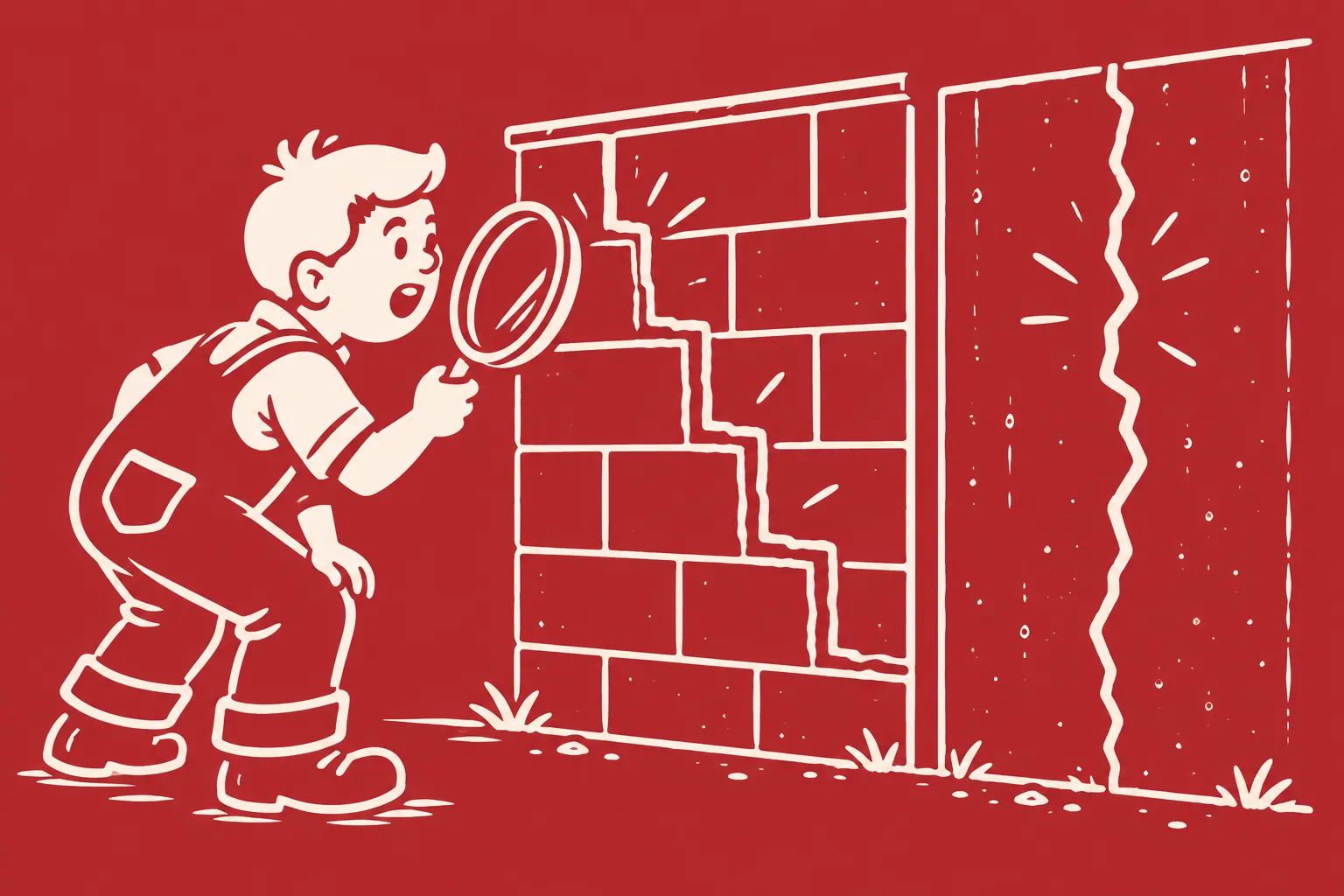
In Michigan basements, thin vertical cracks in poured walls and stair-step cracks near the middle of a block wall usually come from shrinkage as the wall cured or dried. They can leak but are rarely structural. Horizontal cracks, bowing or leaning walls, and cracks that keep widening, no longer line up or run diagonally from a corner point to soil pressure or settling and need a structural engineer first. A crack that only leaks can be sealed from outside.
Almost every basement wall has a crack somewhere. Building scientist Joseph Lstiburek puts it bluntly: “there are only two kinds of concrete…concrete that cracks and concrete that will crack” (Building Science Corporation). So the useful questions aren’t whether your wall is cracked. They are why the crack formed, whether water comes through it, and whether the wall is still moving.
Clark Basement Waterproofing works only on the outside of the foundation, so this guide also says plainly where our work ends and a structural engineer’s begins.
What causes cracks in basement walls?
Basement wall cracks form when the wall shrinks as it cures or dries, when the foundation settles unevenly, or when soil pushes on the wall. Freezing and seasonal temperature swings add to it. The crack’s shape is a good first clue to which one you have, and any of them can let water in when the soil outside is wet. This table follows the Residential Rehabilitation Inspection Guide, which the U.S. Department of Housing and Urban Development (HUD) publishes for evaluating older homes.
| What you see | Usual cause | How serious, and what to do |
|---|---|---|
| Thin vertical crack in a poured wall, often at a corner or window | The concrete shrank as it dried, early in the house’s life | Low concern if it isn’t growing. Seal it if it leaks; mark it and watch it. |
| Stair-step crack along the mortar joints of a block wall, near mid-wall | The block shrank as it dried. These usually form in the first year, then stop. | HUD: “rarely serious.” Seal it if it leaks; mark it and watch it. |
| Diagonal crack near a corner or opening, much wider at one end, or running into the floor or walls above | Uneven settling of the foundation | Can be serious, especially if growing. Structural engineer first. |
| Nearly vertical crack with edges that don’t line up, where a porch, bay window or addition meets the house | The added part settled more than the house | Needs an evaluation. Structural engineer first. |
| Horizontal crack, especially in a block or brick wall, or a wall that bows, bulges or leans in | Soil pressure or vibration: poor backfilling, heavy equipment or vehicles close to the wall, or wet soil swelling or freezing against it | HUD: “potentially serious.” Structural engineer first, then waterproofing. |
| Damp mortar joints or white, chalky deposits on a block wall, with no visible crack | Water moving through the joints or wicking through the block | Not structural by itself. Find where the water comes from. |
Two cautions. First, similar-looking cracks can have different causes. HUD notes that shrinkage cracks in block walls are “often mistaken for settlement cracks,” and that many signs of masonry distress blamed on settling are really caused by moisture and temperature changes. Second, a crack that is harmless to the structure can still let water in. The shape tells you about the wall. A water stain tells you about the water.
How do cracks differ in poured concrete and block walls?
A poured concrete wall is one continuous piece, so it cracks at its weak points, usually corners, windows and other openings. A block wall is many concrete blocks set in mortar, so its cracks tend to follow the mortar joints in a stair-step line. You can usually tell which you have from an unfinished stretch of wall: block shows a grid of rectangles and mortar lines, and a poured wall is one smooth surface.
| Poured concrete wall | Concrete block wall | |
|---|---|---|
| How it’s built | Concrete poured into forms as one piece | Blocks laid in mortar; the blocks are often hollow |
| Typical shrinkage crack | Thin and mostly vertical, often at a corner or opening | Stair-step along the mortar joints, often mid-wall |
| Where water gets in | At cracks and joints; some moisture can also wick through the concrete | At cracks and mortar joints, and by wicking through the block |
| Dampproofing under Michigan’s code (2015 MRC R406.1) | The dampproofing coat goes directly on the concrete | At least 3/8 inch of portland cement parging first, then the dampproofing coat, unless the coating is approved for direct use on masonry |
Solid concrete doesn’t leak. Lstiburek points out that “we build dams out of it,” except where there are cracks or badly built joints. So on a poured wall, look for the leak at a crack or a joint.
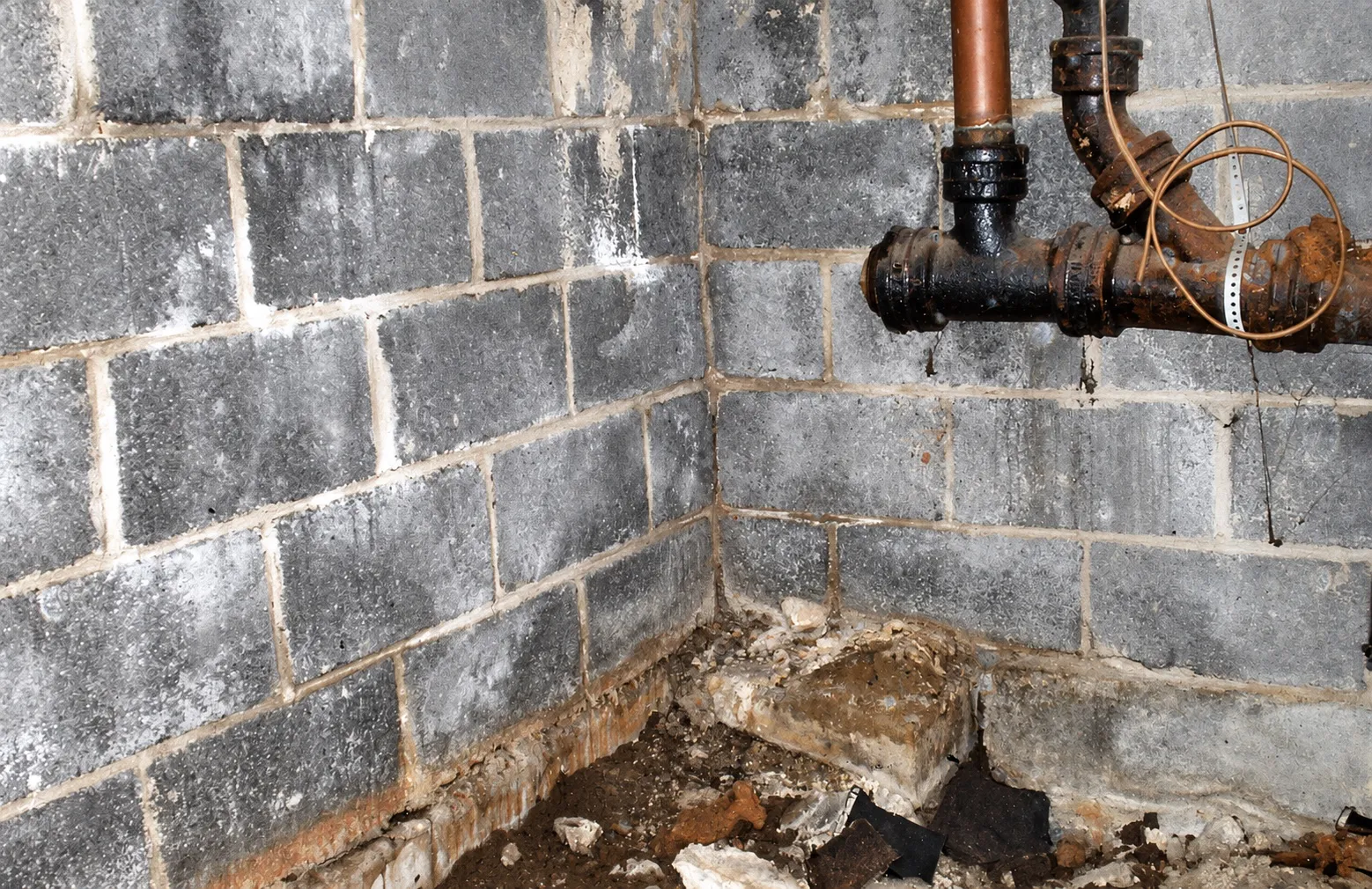
Block walls give water more ways in. A Building Science Corporation report written for the U.S. Department of Energy notes that “water in contact with masonry materials can wick through them,” and that water pressure in wet soil “will push water through any available joints, imperfections, or cracks in the foundation.” Every mortar joint in a block wall is one of those joints, which is how a block wall can leak where you see no crack at all.
Are hairline cracks in a basement wall normal?
Yes, usually. Concrete and block both shrink as they dry. HUD’s guide says shrinkage cracks in block walls usually form during the building’s first year, then show no further movement, and that shrinkage cracking “is rarely serious.” A thin crack that stays dry and doesn’t grow is something to watch, not something to panic about.
A hairline crack is worth a closer look when it:
- leaves a water stain, a damp patch or white deposits after rain;
- gets longer or wider over time;
- has sides that no longer line up;
- runs horizontally, or sits where the wall bulges.
To tell whether a crack is moving, draw a pencil line across each end and write the date beside it. Measure the width at the widest point and take a photo with a ruler next to it. Check again every few months. Some cracks open and close with the seasons, and HUD notes that this kind of movement “may take six months or more to measure,” so compare readings taken at the same time of year.
Look closely at the crack itself too. According to HUD, “a clean crack indicates recent movement,” while a dirty or previously filled crack may be inactive. Age matters as well. The guide’s example: a half-inch crack in a new building may be a sign of rapid settlement, but in a 50-year-old building it may reflect movement of only about 1/100 inch a year.
Why does a crack leak only after heavy rain or at spring thaw?
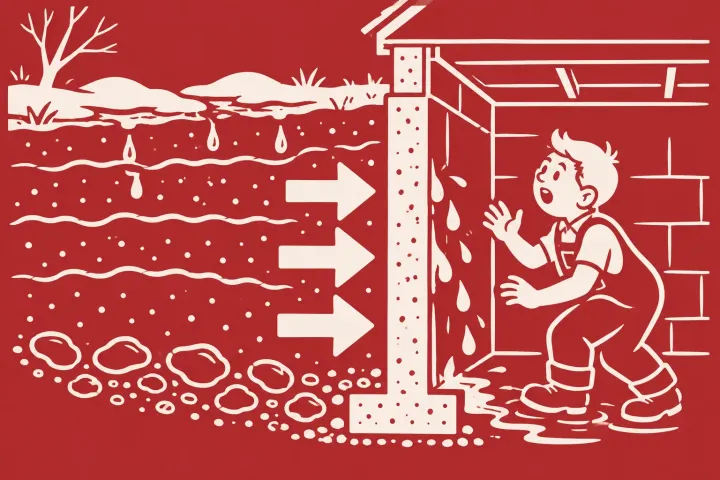
Because a crack only leaks when water reaches it. As Lstiburek puts it, “Water can leak through cracks…but only if water gets to the crack.” In dry weather the soil against your wall may drain well enough that the crack stays dry. After a long rain or a snowmelt, the soil fills with water, and that water presses on the wall.
That push is called hydrostatic pressure. Water weighs about 62.4 pounds per cubic foot (USGS), so each foot of saturated soil against the wall adds roughly 62 pounds per square foot of water pressure at the bottom. That is the pressure that forces water through cracks and joints. Our guide to hydrostatic pressure and spring leaks walks through the numbers.
The soil makes a difference. Across much of St. Clair Shores and nearby Macomb County, USDA soil maps show clay-rich lake-plain soils such as Toledo and Lenawee, which the USDA describes as poorly or very poorly drained. Water leaves that ground slowly. Not every lot is clay; parts of Harrison Township and the Grosse Pointe lakeshore are sandier.
Start with the simple part: keep roof and surface water away from the wall. The BSC report notes that “many problem cases can be solved with grading and surface drainage,” so check your downspouts and the slope of the ground (see exterior water management). If the crack still leaks, the wall needs sealing and the water at the footing needs a way out, which is the job of drain tile.
Before you blame the crack, make sure it is the source. Water that comes up through a floor drain during a big storm is usually a sewer backup, which a plumber handles and sealing a wall won’t stop (see sewer backup vs. seepage). Damp walls with no rain involved can be condensation. Our guide to why basements leak helps you sort it out.
When should you call a structural engineer about a crack?
Call one before anyone seals the crack if you see signs the wall is moving. HUD’s inspection guide points to these:
- A horizontal crack, especially in a block or brick wall. HUD calls it “potentially serious” because it means the wall carrying part of the house is “bent” or “broken.”
- A wall that bows, bulges or leans inward.
- A crack that keeps getting wider, or whose sides no longer line up.
- A crack that continues into the floor slab, the walls above or the plaster inside the house.
- Other signs of settling: doors and windows that stick, sloping floors, and warped door or window frames.
HUD advises bringing in a structural engineer when masonry shows problems like these, and a soils engineer as well when the cause looks like uneven settling. Water is often part of the story. For horizontal cracks, HUD lists the swelling or freezing of water-saturated soil among the causes. Where swelling soil is suspected, it tells inspectors to look outside for water sources such as broken downspouts and poor surface drainage.
The repair has to match the cause. The U.S. Bureau of Reclamation’s Guide to Concrete Repair warns that when the wrong method is used, “cracks will usually reoccur.” An engineer decides how a moving wall should be repaired. Waterproofing comes after that plan, not instead of it.
What Clark does and doesn’t do. Clark Basement Waterproofing seals and waterproofs foundation walls from the outside. We don’t straighten or reinforce walls. If we see signs that your wall is moving when we come out for the free estimate, we’ll tell you to get a structural engineer’s opinion before any waterproofing is done.
Should a leaking crack be sealed from outside or injected from inside?
Either can stop a leak. The difference is where the water is stopped. Injection fills the crack from the basement side. Sealing from outside stops water where it enters the wall, and the wall around the crack gets coated too.
The Bureau of Reclamation’s guide describes the two common injection materials. Epoxy rebonds cracks that are “dormant and relatively dry.” Polyurethane seals cracks that leak, but it “cannot normally be used for structural rebonding.” Injection is often the practical choice where nobody can dig, such as a wall under an addition.
Clark works only from the outside, and we dig by hand. We dig down to the footing, seal the crack with hydraulic cement, coat the wall around it with tar and cover it with a waterproof membrane, then backfill and restore the yard. Coating the wall, not just the crack, matters because, as Lstiburek notes, “it is not always possible to predict where all the cracks will appear.”
A porch, stoop or driveway over the wall doesn’t rule out outside work. We cut the concrete, waterproof the wall under it and replace the concrete (see waterproofing under porches and concrete). Most jobs take 3–7 days and come with a written 10–15 year warranty; the length depends on the job. For a side-by-side of the two approaches, see foundation crack repair and our interior vs. exterior comparison.
Do Michigan winters make basement wall cracks worse?
They can. Water in a crack expands when it freezes; the USGS says ice is about 9 percent less dense than liquid water. Michigan’s residential code sets the frost line at 42 inches and rates the state’s weathering exposure for concrete as “severe” (2015 MRC Table R301.2(1)). So the upper part of a basement wall sits in ground the code expects to freeze.
HUD’s guide lists freeze-thaw cycles among the causes of masonry cracking, and the freezing and heaving of water-saturated soil among the causes of horizontal cracks in block and brick walls. It even tells inspectors to suspect frost heaving when the damage sits above the local frost depth. There is no reliable figure for how fast freezing widens a crack, so we won’t quote one. The practical point is simple: a crack that stays wet going into winter has water in it to freeze.
Should you buy a house with a cracked basement wall?
A crack alone isn’t a reason to walk away. What matters is what kind of crack it is and whether water has been coming through it. A dry hairline shrinkage crack is common. A horizontal crack, a bowing wall or signs of settling call for a structural engineer’s report before you commit.
What to check and ask:
- The seller’s disclosure. Michigan’s Seller Disclosure Act form asks whether there has been evidence of water in the basement or crawl space, and about “settling, flooding, drainage, structural, or grading problems.”
- Signs of past water. HUD lists dampness, water stains, peeling paint and efflorescence (white mineral deposits) as signs that water is getting through.
- Patched or freshly painted cracks. A previously filled crack may be inactive, but ask when and why it was patched, and whether it was sealed from inside or outside.
- Your city’s rules at sale. In Grosse Pointe Woods, for example, the certificate of occupancy inspection required when a home changes hands checks basement walls for “evidence of foundation failure” (Sec. 8-69).
If a crack leaks, a free on-site estimate tells you what the fix involves, which is worth knowing before you close. We call back within a day. This isn’t legal advice; your agent or attorney can tell you how to use what you learn.